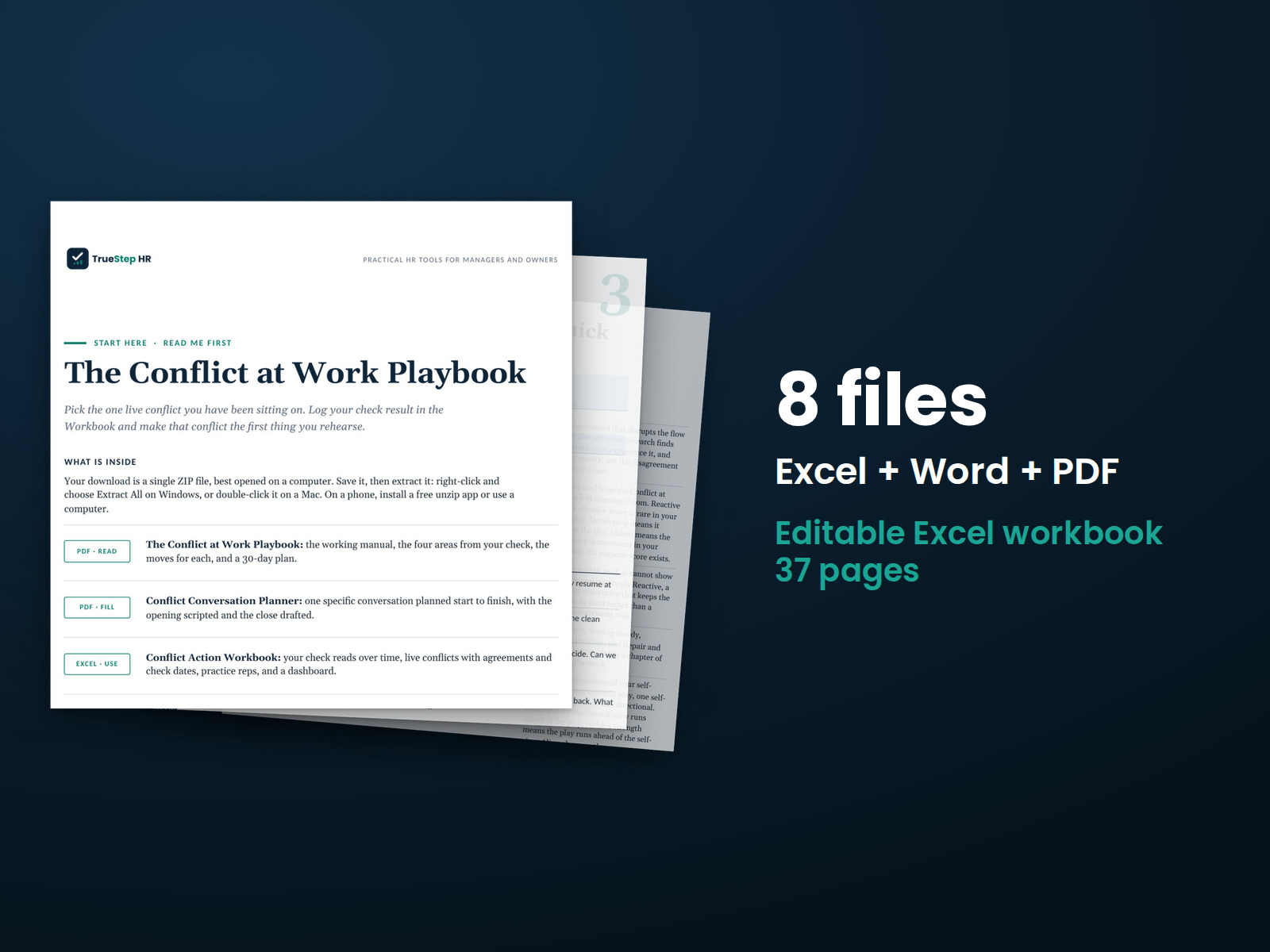
Real pages from the kit files. Example details are illustrative.
Conflict at Work Playbook
The cost of a conflict is set by the handling, not by the disagreement. This kit works on exactly that: the working manual for raising issues early, staying steady under heat, negotiating on interests instead of positions, and closing conflicts so they stay closed, built on the published research behind the free Conflict at Work Check and matched to its four areas.
One-time purchase, no subscription. Instant download.
Built to the TrueStep HR standard
- The 12-page Playbook: what conflict costs and the two dials behind every style, how to read your check result and its gap read honestly, a chapter of moves for each of the four areas, the traps that undo the work, and a 30-day plan
- The Conflict Conversation Planner: one specific conversation planned start to finish, a one-page map of the conflict, the opening scripted word for word, the moves for whatever comes back, and the close that makes it stick
- Conflict Scripts and Templates: eight verbatim scripts for the moments that decide a conflict, raising it early, answering heat, the interest question, the joint escalation, plus an agreement note template in Word
- The Action Workbook: every check read logged over time, live conflicts with agreements and check dates, practice reps, and a dashboard that shows the current state, in Excel or Google Sheets
The kit gives you the moves, the plan, and the record. The judgment calls in the room stay yours, and it names what never belongs in a peer conversation.
14-day money-back guarantee. If it does not help, email us and we refund you.
A personal development tool. The check reads are your own scenario play and self-view, never a measure of any other person, and nothing in this kit belongs in a hiring, selection, or evaluation decision. Anything involving possible harassment, discrimination, threats, or safety goes to HR or qualified counsel the same day, outside this process.
Not the right fit? Take the 60-second match.
Buying for clients or multiple entities? The White-Label tier is in the license.
Four working files, built to be used together
Read the Playbook chapter for your weakest check area, log the read and your first live conflict in the Workbook, plan the conversation with the Planner and hold it within two weeks, and open the Scripts when the moments come. The Start Here maps the order.
Start Here
A one-page map of the kit and the order to use it: Playbook first, starting with your weakest area, then the workbook log, then the conversation you have been avoiding planned and held within two weeks, then the scripts for the moments in between.
The Playbook (12 pages)
Ten sections: what conflict costs, with the research numbers, and the two dials behind the five handling styles; reading your check result, including the gap read between your self-view and your scenario play; a chapter of moves for each of the four areas, Raising It Early, Staying Steady, Working the Problem, and Repair and Follow-Through; the conversation itself; the 30-day plan; the six traps; and the boundaries, what goes to HR and how the moves change upward.
The Conflict Conversation Planner (4 pages)
One specific conversation, start to finish: a one-page map of the conflict with both interests and your default-style risk, the opening scripted word for word, the moves for heat, new information, restated positions, and deflection, and the close, with the recovery moves if it goes sideways.
Conflict Scripts and Templates
Eight scripts with the words close to verbatim: raising the issue early, answering heat with a paraphrase, naming the loop and taking the break, the interest question, taking a grievance list, repairing after you went sharp, naming a returned pattern, and the joint escalation. Plus the agreement note template and the check-in agenda.
The Action Workbook
Six tabs: a Start Here, the Check Log that holds every read and gap read over time, Live Conflicts with agreements and check dates, Practice Reps, a computed Dashboard, and a Definitions reference. Works in Excel or Google Sheets.
The method, in the order the work runs
Read your handling honestly, run the moves on live situations, hold the conversation you have been avoiding, close it in writing, and re-check after a month. The kit structures each step; the words in the moment are yours.
Read the read
Take the free Conflict at Work Check, log the bands and the gap read in the workbook, and take the gap read seriously: the research finds most people rate their conflict handling higher than the people around them do, and the check is built to surface exactly that.
Run the first moves
Open the chapter for your weakest area and start its first two moves on live situations, logged as reps. Whatever the weakest area is, install the paraphrase reflex and the one-week rule: they carry every other move.
Hold the avoided conversation
Pick the conflict you have been sitting on and run the Planner on it page by page: the map, the scripted opening, the moves for what comes back. Hold it within two weeks, in a channel with tone, never a message thread.
Close it in writing
Three sentences the same day: what we agreed, who does what, when we check. Log the agreement and the check date in the workbook, and actually hold the check-in, especially when things seem fine.
Re-check and keep it
Re-run the check at day 30 and log it next to the first read. The honest test is not the band; it is whether the gap between an issue appearing and the issue being worked is shorter than it was a month ago. The workbook holds the trend.
Conflict skill is handling, and handling is learnable
The expensive conflicts follow a pattern: sat on until they are big, run hot until nobody can think, traded as positions until rank decides, and closed on good feelings that unravel in three weeks. The fix is not a personality change. It is a small set of moves, run deliberately on live situations, with the record kept. That is what this kit operationalizes.
The kit names what is not a conflict-skill problem
Most workplace conflicts are squarely yours to work. Some situations only look like peer conflicts, and the kit marks them, so the right channel handles them promptly.
Who does what
The kit, you, and the debrief each carry a specific part. Here is the split, stated plainly.
- The kit carries the structure; you carry the reps. The moves, the planner, the scripts, and the workbook organize the work. The paraphrase under real heat and the opening said out loud are the parts only you can run, and they are what move the bands.
- The kit scripts the openings; the listening is the skill. The frameworks organize what you say. What you do with what comes back, the constraint you did not know, the heat, the restated position, is the craft, and the Playbook trains exactly that.
- The kit holds the record; the record keeps you honest. Reads logged over time, agreements with check dates, and reps on real friction are what separate a changed pattern from a good intention.
- When you want a senior read on the live one, the Debrief carries it. Thirty minutes with Greg Best, SPHR, on your check result and the specific conflict in front of you, ending in what to do first.
Who it is built for
Who this kit fits, and where to go if that is not you.
Built for
- Anyone sitting on a work conflict right now, a colleague they route around, a negotiation stuck on positions, a conversation they keep rehearsing, who wants it worked and closed properly.
- A manager or team lead who just ran the free Conflict at Work Check and wants to act on the result, especially a Reactive area or a Blind spot gap read.
- An HR leader or owner equipping managers whose conflicts keep landing on HR three weeks later than they should have.
If you are looking for
- The wider emotional skill behind the moments, reading the room, managing your own reactions, rather than the conflict system. The EQ at Work Field Guide is built for that.
- A formal complaint or a specific workplace concern to look into, which is an investigation, not a peer conversation. The Employee Relations and Workplace Investigations Kit runs that process.
- A team whose problem is silence rather than friction, where issues never surface at all. The free Psychological Safety Team Check is the place to start.
Before you buy
What format are the files and can I edit them?
Do I need to take the free Conflict at Work Check first?
Is this for managers only?
Can I use this for hiring or performance reviews?
How is this different from a free article about conflict styles?
What is the refund policy?
What happens after I buy?
Can I expense this purchase to my business?
Most customers buy TrueStep HR tools for business use, and a tool you use for work often qualifies as a deductible business expense. Whether it does for you depends on your situation, so confirm with your accountant or tax professional. Your receipt arrives by email at checkout and works as documentation.
The 6 red flags to check before you discipline or fire someone
A five-minute screen to run before you act. Free PDF, sent to your inbox. Unsubscribe anytime.
This kit is built on the published research. Read the basis yourself:
What buyers say
Make the next conflict cost less than the last one
The moves per area, one conversation planned start to finish, the scripts for the moments in between, and the record that keeps it honest, in files you keep.