Team development kit

Psychological Safety Playbook

Your team decides how safe it is to speak up by watching what happens to the last person who did. This kit works on exactly that mechanism: the manager operating manual for a team that raises problems early and still holds a high bar, built on the published research construct behind the free Psychological Safety Team Check and matched to its four areas.

$89USD

One-time purchase, no subscription. Instant download.

Built to the TrueStep HR standard

  • The 12-page Playbook: what psychological safety is and is not, how to read your Team Check result honestly, a chapter of specific moves for each of the four areas, the traps that undo the work, and a 30-60-90 plan
  • The Team Conversation Guide: a 45 minute meeting word for word, from the opening that makes the room safer to the six questions in order, the quiet-room moves, and the four week follow up
  • Manager Scripts and Templates: eight verbatim scripts for the moments that build or break safety, receiving bad news, an admitted mistake, a missed commitment, plus a team working agreement template in Word
  • The Action Workbook: every Team Check read logged over time, commitments with owners and review dates, the team norms, and a dashboard that shows the current state, in Excel or Google Sheets

The kit gives you the moves, the meeting, and the record. The judgment calls in the room stay yours, and it names what never belongs at the team-norms level.

14-day money-back guarantee. If it does not help, email us and we refund you.

One-time purchase Instant download Editable files

A team development tool. The Team Check reads are a manager’s view of team conditions, never a measure of any individual, and nothing in this kit belongs in a hiring, selection, or evaluation decision. Anything involving possible harassment, discrimination, or retaliation goes to HR or qualified counsel promptly, outside the team-norms process.

Not the right fit? Take the 60-second match.

Buying for clients or multiple entities? The White-Label tier is in the license.

One-time purchaseNo subscription
Instant downloadFiles you keep
Editable filesExcel, Word, PDF
14-day guaranteeMoney back
Secure checkoutSSL encrypted
What you get

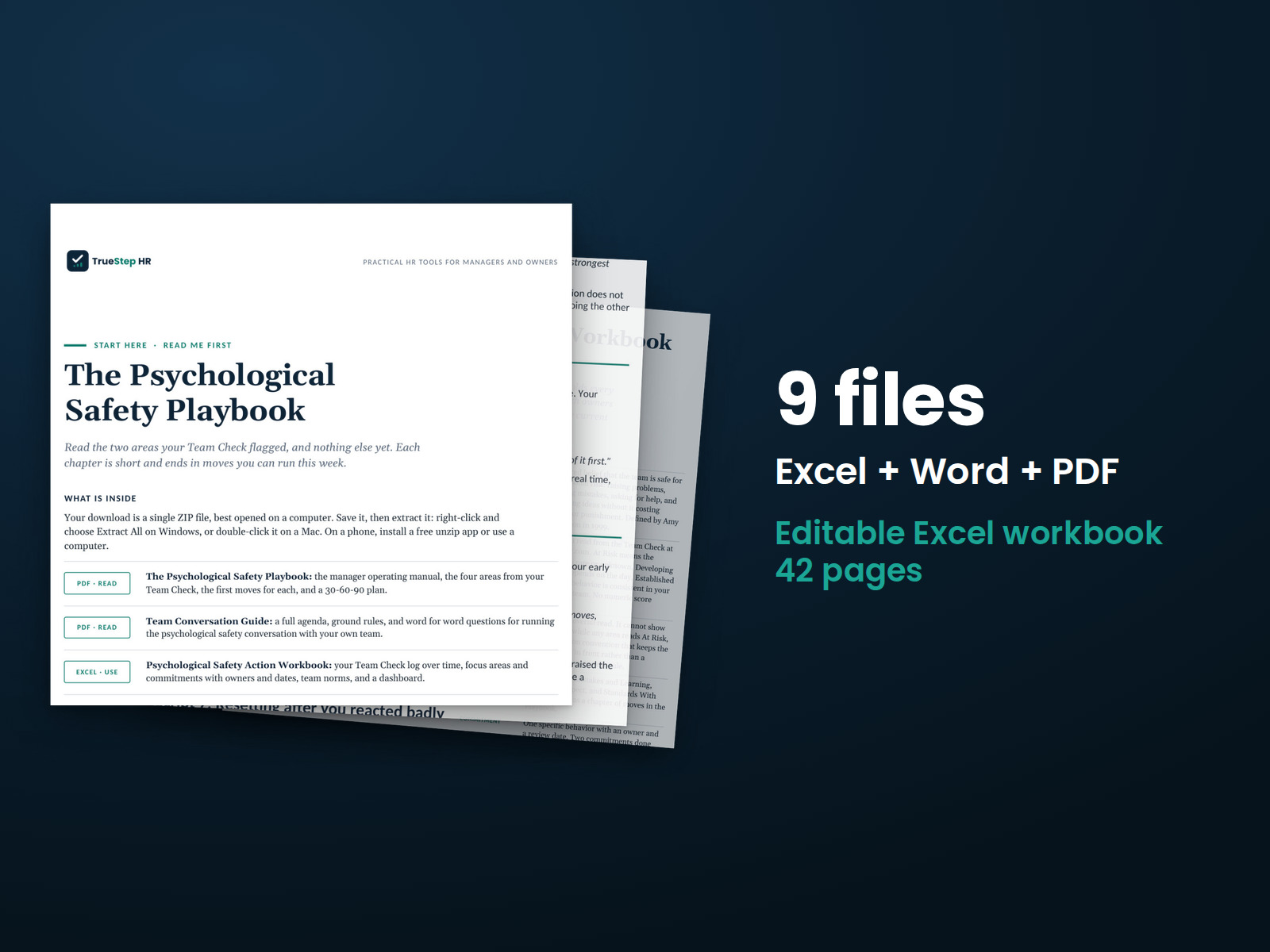
Four working files, built to be used together

Read the Playbook chapter for your weakest Team Check area, log the read and your first two commitments in the Workbook, run the meeting from the Conversation Guide, and open the Scripts when the moments come. The Start Here maps the order.

PDFStart here

Start Here

A one-page map of the kit and the order to use it: Playbook first, starting with your weakest area, then the workbook log, then the team conversation within two weeks, then the scripts for the moments in between.

PDFRead first

The Playbook (12 pages)

Ten sections: what psychological safety is and is not, including why it works only next to a high bar; reading your Team Check result, with the honest caveat about manager reads; a chapter of moves for each of the four areas, Speaking Up, Mistakes and Learning, Help and Respect, and Standards With Safety; the team conversation; the 30-60-90 plan; the six traps that undo the work; and keeping it, including the moment to bring in a facilitator.

PDFRun the meeting

The Team Conversation Guide (4 pages)

A 45 minute meeting end to end: ten minutes of prep, the timed agenda, the opening close to verbatim, two silent write prompts, six discussion questions in order, the quiet-room moves, the two rules you must keep afterward, and the fifteen minute follow up four weeks later.

DOCXWord

Manager Scripts and Templates

Eight scripts with the words close to verbatim: receiving bad news, an admitted mistake, admitting your own, inviting real dissent, when someone gets talked over, an overload flag, resetting after you reacted badly, and a missed commitment held directly. Plus the team working agreement template and the follow up agenda.

XLSXExcel

The Action Workbook

Six tabs: a Start Here, the Team Check Log that holds every read over time, Focus Areas and Commitments with owners and review dates, the Team Norms sheet, a computed Dashboard, and a Definitions reference. Works in Excel or Google Sheets.

How it works

The method, in the order the work runs

Read your team honestly, run the first moves, test your read against the team’s in one structured conversation, hold both dials, and re-check on a cadence. The kit structures each step; the responses in the moment are yours.

STEP 01

Read the read

Take the free Team Check, log the bands in the workbook, and treat the result as a hypothesis rather than a grade. Manager reads run optimistic, because the people least likely to feel safe are also the least likely to show it, and the Playbook says exactly how to correct for that.

STEP 02

Run the first moves

Open the chapter for your weakest area and start its first two moves, with dates in the workbook. Whatever the weakest area is, install the response discipline: thank the next person who brings a problem, ask before you react, and change something visible because they raised it.

STEP 03

Hold the team conversation

Within two weeks, run the 45 minute meeting from the Conversation Guide: your opening owns a share of the problem first, the silent write protects the quiet voices, and the six questions surface what your read missed. Leave with two team commitments and one of yours.

STEP 04

Hold both dials

Keep the bar written and real while the safety builds: misses get discussed early and plainly, honest errors get curiosity and a fix, and cut corners get a direct conversation about the standard. Safety without standards is comfort; the scripts carry the words for both.

STEP 05

Re-check and keep it

Re-run the Team Check at day 90 and log it next to the first read. The honest test is not the band; it is whether bad news reaches you earlier than it did three months ago. Safety is re-earned after every reorganization, miss, and new hire, and the workbook holds the trend.

The standard

Candor is built by responses, not announcements

Teams go quiet in predictable ways: a defensive reaction to the last piece of bad news, a mistake that got treated as a scorecard entry, a dissenter who got talked over while the manager watched. The fix is not a speech about openness. It is a small set of responses, run consistently, with the standard held the whole time. That is what this kit operationalizes.

The response to the first person who speaks up sets the norm for everyone after. One defensive reaction buys weeks of silence, and one well-received piece of bad news, thanked, explored, and visibly acted on, teaches the whole team that telling you today is the smart move.
Safety and standards are two dials, and you need both high. High standards with low safety produces hidden problems; high safety with low standards produces a comfortable team that drifts. The research behind the construct is explicit that performance lives in the learning zone where both hold, and every chapter turns one dial without releasing the other.
Better teams surface more errors, not fewer. Edmondson’s original 1999 finding is the spine of the Mistakes chapter: reporting goes up before outcomes improve, because you finally see what was always there. The kit prepares you for that dip so you hold your nerve instead of reverting.
A manager read is a starting point, never a verdict. Psychological safety is measured by what the team believes, so the kit treats your Team Check result as a hypothesis, scripts the conversation that tests it, and bans the result from ever appearing in anyone’s review.

The kit names what is not a team-norms problem

Most of this work is squarely a manager’s to run. Some situations only look like norms problems, and the kit marks them, so the right channel handles them promptly.

Anything that looks like harassment, discrimination, or retaliation goes to HR or qualified counsel, not into a norms conversation A performance problem that coaching has not moved belongs in your formal performance process with HR A step toward discipline or an exit is a decision made with HR, never a team exercise If the team conversation stalls twice, or the careful subject in the room is you, bring in a facilitator from outside the reporting line

Who does what

The kit, you, and the facilitated session each carry a specific part. Here is the split, stated plainly.

  • The kit carries the structure; you carry the responses. The moves, the meeting, the scripts, and the workbook organize the work. The response when bad news actually lands is the part only you can run, and it is the part the team is watching.
  • The kit scripts the conversation; the team writes the norms. The Conversation Guide gives you the words to open and ask. The working agreement only works in the team’s own words, and the template is built to be filled in the room.
  • The kit holds the record; the record keeps you honest. Reads logged over time, commitments with dates, and a four week follow up on the actual list are what separate a changed team from a good meeting.
  • When the room needs an outside voice, the Team Session carries it. A facilitated 90 minute working session on your Team Check result with Greg Best, SPHR, for the moments a manager cannot facilitate honestly from inside the reporting line.
Is this for you

Who it is built for

Who this kit fits, and where to go if that is not you.

Built for

  • A manager or team lead who hears about problems late, sees quiet meetings and loud hallways, or just ran the free Team Check and wants to act on the result properly.
  • An HR leader or owner equipping managers after a rough engagement survey, a reorganization, or a stretch of surprises that should have surfaced earlier.
  • A demanding leader who has no intention of lowering the bar and wants the version of this work that pairs candor with accountability instead of trading one for the other.

If you are looking for

  • The everyday management fundamentals, one-on-ones, feedback, documentation, and attendance, rather than the team climate work. The People Manager Toolkit is built for that.
  • A formal complaint or a specific workplace concern to look into, which is an investigation, not a norms exercise. The Employee Relations and Workplace Investigations Kit runs that process.
  • Your own development in reading and managing emotion at work, rather than the team system. The free EQ at Work assessment is the place to start.
Questions

Before you buy

What format are the files and can I edit them?
The Playbook, the Conversation Guide, and the Start Here are print-ready PDFs, the Action Workbook is an Excel file that also works in Google Sheets, and the Scripts and Templates are an editable Word file. Everything is yours to keep and adapt to your team.
Is this a survey of my team?
No. The free Team Check at truestephr.com is answered by you, the manager, about your team, and this kit says so plainly: your read is the starting point for a conversation with the team, not a measured team survey. The Conversation Guide exists exactly to test your read against theirs, in the room.
Do I need to take the free Team Check first?
It is the natural starting point, because the Playbook chapters map to its four areas and the workbook logs its reads over time. But the kit stands on its own: if you already know your team goes quiet around bad news, start with the Speaking Up chapter and run the conversation.
Can I use this for hiring or performance reviews?
No. This is a team development tool. Psychological safety is a property of a team, not a grade on a person, and nothing in this kit, including anything said in the team conversation, belongs in a hiring decision or an individual performance evaluation. The kit states that boundary out loud and tells you to state it to your team.
How is this different from a free article about psychological safety?
An article tells you the concept. This is the operating system: the specific moves per area with the words to say, a 45 minute team meeting scripted end to end including what to do when the room goes quiet, a working agreement template, and a workbook that holds commitments with dates and tracks reads over time. It is also honest about the hard parts, like what a quiet room means and why a lower second read can be progress.
What is the refund policy?
Digital products are covered by a 14-day money-back guarantee. See the refund policy for the full terms.
What happens after I buy?
Checkout delivers an instant download link, and a receipt with the same link arrives by email. Open the Start Here page first: it maps the four files and the order to use them, starting with your weakest Team Check area. Questions? Email support@truestephr.com.
Can I expense this purchase to my business?

Most customers buy TrueStep HR tools for business use, and a tool you use for work often qualifies as a deductible business expense. Whether it does for you depends on your situation, so confirm with your accountant or tax professional. Your receipt arrives by email at checkout and works as documentation.

Free guide

The 6 red flags to check before you discipline or fire someone

A five-minute screen to run before you act. Free PDF, sent to your inbox. Unsubscribe anytime.

The method behind this

This kit is built on the published research construct. Read the basis yourself:

Get the kit

Make telling you today the smart move

The moves per area, the meeting word for word, the scripts for the moments in between, and the record that keeps it honest, in files you keep.

$89
One-time purchase, no subscription. Instant download.