

Employee Cost Calculator
See the full cost of an employee, including salary, payroll taxes, benefits, workers’ comp, paid time off, and overhead. The workbook calculates the fully loaded annual cost, monthly cost, and real hourly rate.
HR advisory, assessments, and operating tools for U.S. businesses
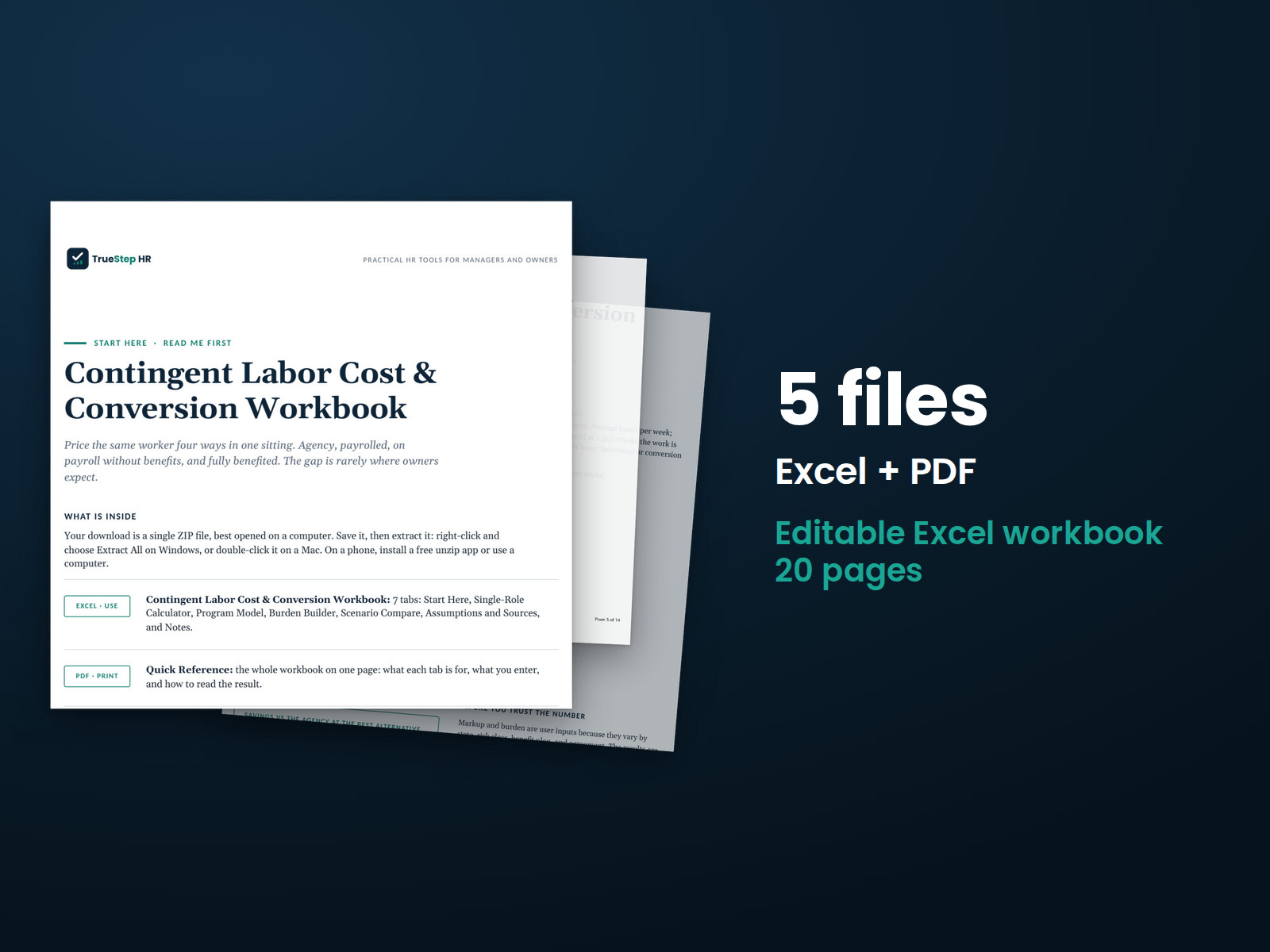
These previews show pages from the files you receive.
Calculator workbook
Would moving agency workers onto payroll save money? Compare four staffing options side by side using your own costs, with sources for every default assumption.
The free browser version offers a quick comparison. The workbook adds a multi-role program model, a burden builder for your actual rates, saved scenarios, and a sourced assumptions tab.
$39
Checkout takes place on our store at shop.truestephr.com. Any applicable sales tax appears at checkout before you pay. These files provide general HR information, not legal advice.
Need approval first?
Ready to put your tool to work?
Bring your purchased tool and the situation you are working through. A TrueStep HR practitioner will help you set the inputs, make the first decisions, and identify a practical next step.
See the Setup Session →Where to start
See how costs differ between agency staffing, payrolling, direct payroll without benefits, and fully benefited employment.
Fit
What is inside
Taken from the kit’s own Start Here guide, so what you see here is what you open after checkout.
How to use it
Contingent labor is often a company's largest expense outside payroll, and those workers sit outside HRIS headcount. This workbook compares four ways to staff the same workers: agency billing, a payrolling arrangement with a lower markup, direct payroll without benefits, and fully benefited employment. See the total cost of each option, savings compared with agency staffing, and how quickly those savings cover any conversion costs. The Program Model extends the comparison across every pay band in your contingent program. The Burden Builder replaces default rates with your actual costs. Scenario Compare shows the financial difference between keeping your current arrangement, converting some workers, or converting the entire program.

Before you buy
Find details about file formats, delivery, licensing, and refunds.
You receive 4 PDF guides and 1 Excel workbook, all named in the What is inside section above. This is a one time purchase, delivered as a download, not a subscription.
Yes. The first image shows the file set, and the second and third show actual pages from the current download.
Yes. You can fill in the Excel workbook for your own internal operations and read or print the PDF guides.
For help implementing this tool, book a one hour Setup Session for $149. For broader HR support, advisory begins with a short request and a written scope at truestephr.com/pages/advisory. For legal questions, consult qualified counsel.
Right after payment, your download link appears on the confirmation screen and again in your email receipt. All files arrive as one ZIP. No account is needed.
You can use Excel, LibreOffice on a computer, or Google Sheets in a browser. LibreOffice and Google Sheets are free alternatives. Any PDF reader opens the guides. See download help.
Email support@truestephr.com within 30 days for a full refund. No form or explanation is required. The full terms are in the refund policy.
No. It is general HR information and a working method. It is not written to any one state unless the page says so. Where a decision turns on the law, use qualified counsel. See what we cover, and what we do not.
One license covers the internal HR work of one legal entity. You may edit the files, brand them, and issue them to your employees. Consultants and groups with several entities need the extended license. See the license.
Extend the system
Explore related tools for the same situation, operating method, or industry.
See the full cost of an employee, including salary, payroll taxes, benefits, workers’ comp, paid time off, and overhead. The workbook calculates the fully loaded annual cost, monthly cost, and real hourly rate.
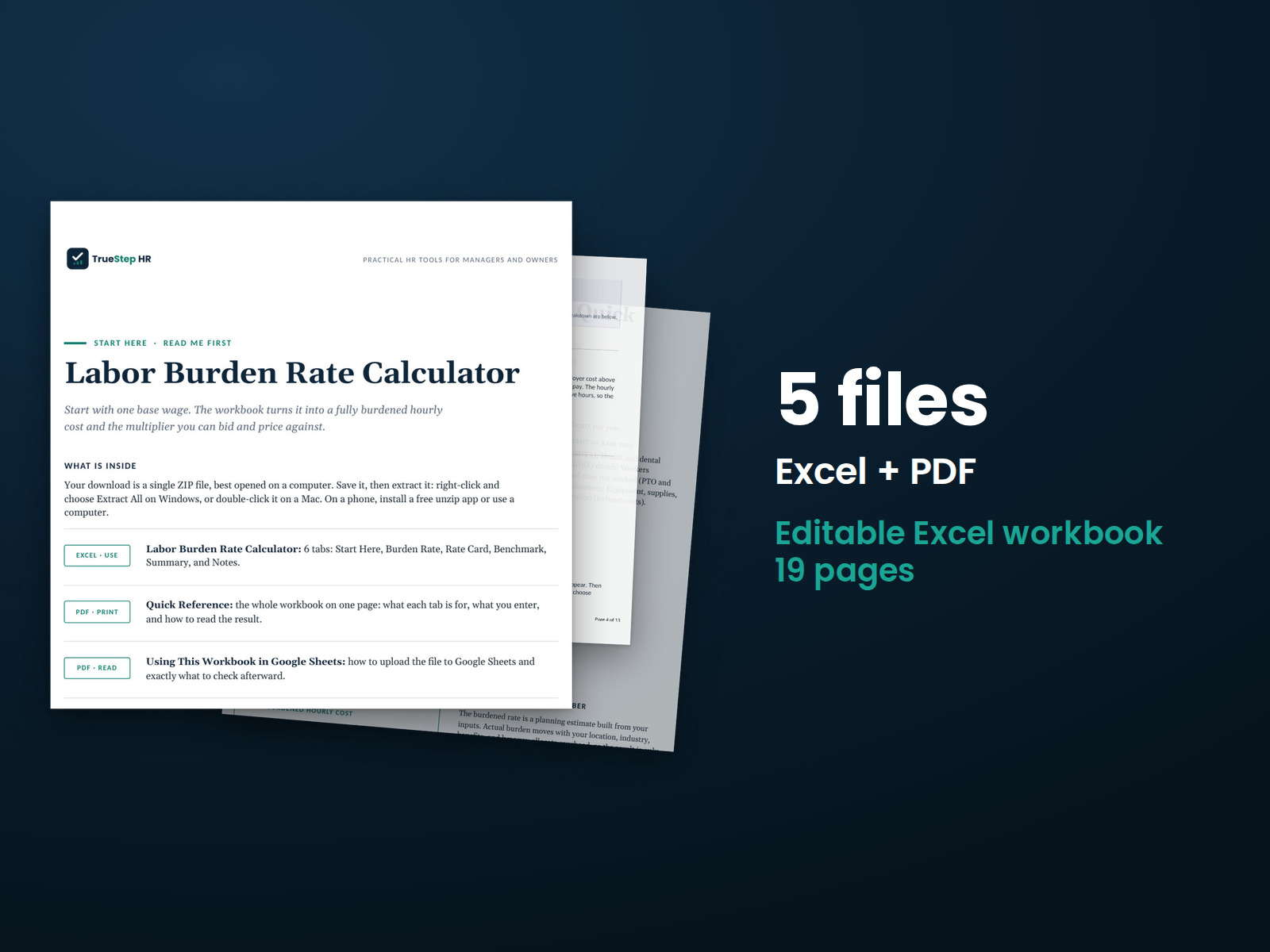
Know what each productive hour costs before pricing work or preparing a bid. The workbook combines salary and employer costs, then divides the total by productive hours to calculate your fully burdened hourly cost and multiplier on base pay.
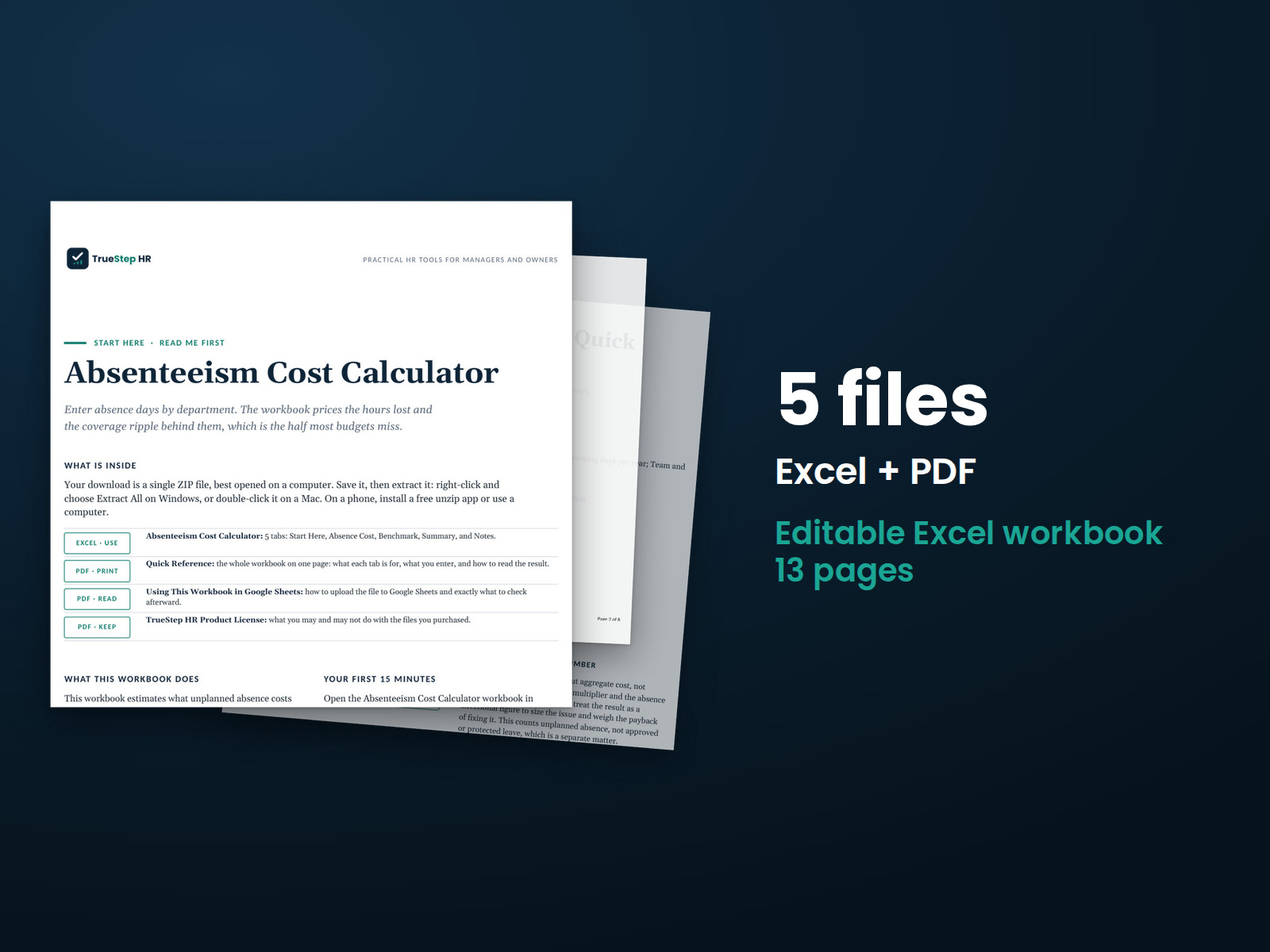
Put a number on what unplanned absences cost your business. Enter each department’s headcount, pay, and absence days.