HR calculator

Labor Burden Rate Calculator

Turn a salary into the number you can price and bid against: the fully burdened hourly cost and the multiplier on base pay. Set each employer cost, and the workbook divides the all-in cost across the productive hours you really get.

$29USD

One-time purchase, no subscription. Instant download.

Built by expert HR practitioners and leaders

  • The fully burdened hourly rate and the multiplier on base pay: a salary and your productive hours turned into the all-in cost of an hour and the multiplier for each dollar of pay, with every formula visible and editable in Excel or Google Sheets
  • A full component breakdown: payroll taxes, health and retirement, paid time not worked, workers compensation, training, equipment, and overhead, each shown in dollars and as a share of total burden, so you can see what drives the number
  • A Rate Card across roles: one burden profile applied to a list of roles at once, with a burdened hourly rate and a fully burdened annual cost for each and a team total, so you get a rate to bid for every role
  • Sourced benchmarks for every component: a Benchmark tab with current figures from SSA, IRS, BLS, and workers-compensation sources, plus typical total burden by sector, to sense-check each input before you trust it
  • A working file you keep: a pre-filled worked example, a board-ready one-page Summary, your numbers saved, and the method documented in plain English, not a one-time screen

The workbook computes from the numbers you enter. Your salary, productive hours, and each burden component are yours to set.

One-time purchase Instant download Editable files 14-day guarantee

Planning estimates and general business information, not legal or tax advice. The result moves with your location, industry, benefits, and how you allocate overhead, so it is only as good as the components you enter. Confirm your actual payroll and benefits costs before you set a billing rate or make a binding decision.

Not the right fit? Take the 60-second match.

Last reviewed June 2026

One-time purchaseNo subscription
Instant downloadFiles you keep
Editable filesExcel, Word, PDF
14-day guaranteeMoney back
Secure checkoutSSL encrypted
What you get

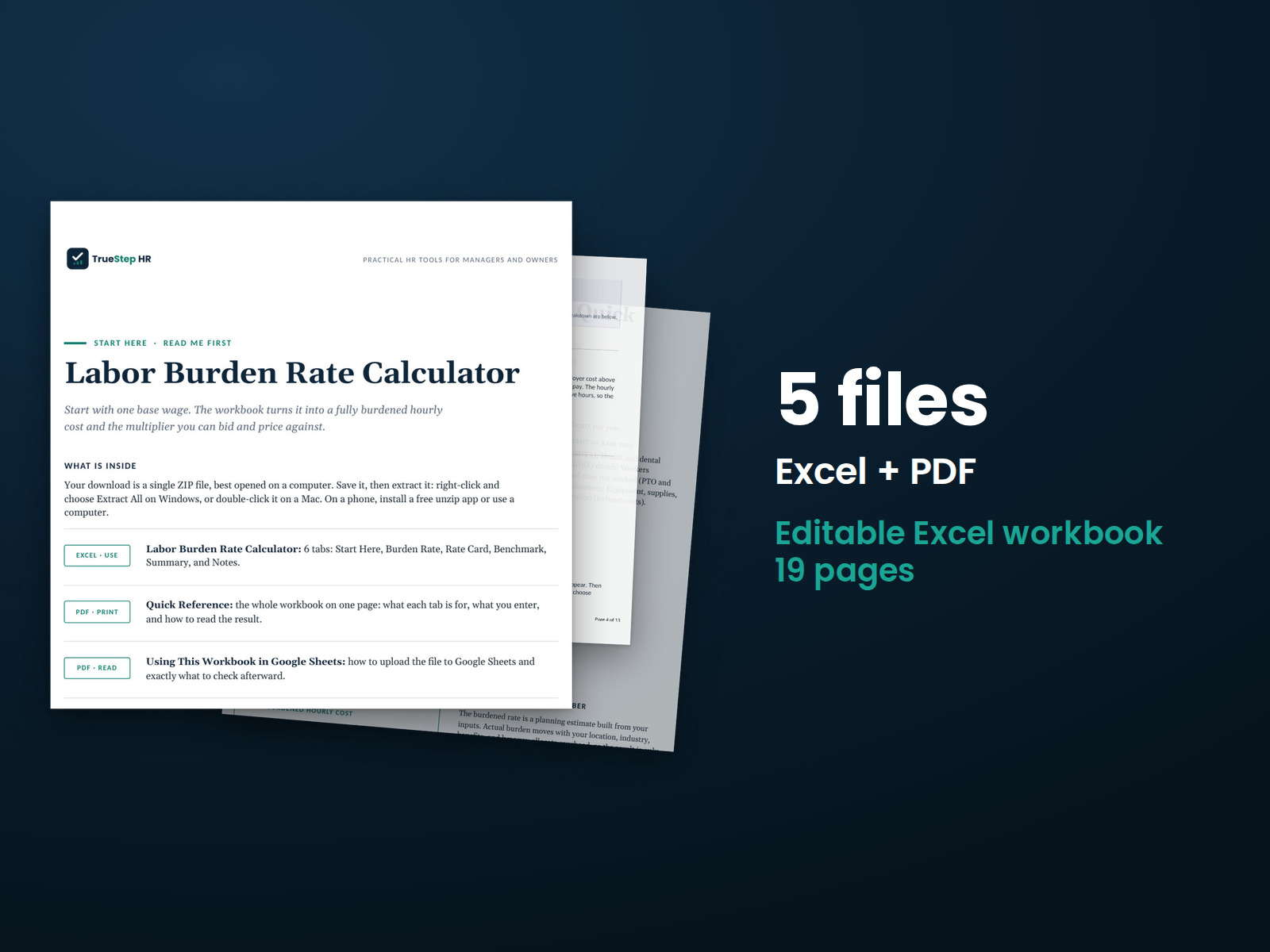
One Excel workbook that turns a salary into a fully burdened hourly rate and a multiplier

A working model, not a blank sheet. You enter a salary, the productive hours, and each employer cost, and the workbook returns the burdened rate, the multiplier, and a full breakdown. It opens on a worked example so the logic is clear before you change anything.

XLSXExcel + Sheets

Labor Burden Rate Calculator

Enter the annual salary and the productive hours you expect, then set each burden component as a percent of base pay. The workbook returns the total burden amount, the burden percent, the multiplier on base pay, the base hourly rate, the fully burdened hourly rate, and a component breakdown that shows each cost in dollars and as a share of total burden.

XLSXBuilt in

A Rate Card across roles, a board-ready summary, sourced benchmarks, and the method in plain English

A Rate Card tab applies one burden profile across several roles at once and returns a burdened hourly rate and a fully burdened annual cost for each, with a team total. A one-page Summary carries the multiplier and the fully burdened rate for a leadership conversation, a Benchmark tab holds current figures from SSA, IRS, BLS, and workers-compensation sources, and the Notes tab documents how each number is built.

How it works

Three steps from a salary to a rate you can bid

You enter a salary and the productive hours, set each employer cost, and read the rate. The workbook does the rest.

STEP 01

Enter the salary and the productive hours

Fill the amber cells: the annual salary, the productive hours you expect, and a job title if you want one. The worked example runs a $75,000 role at 2,080 hours, change it to your own numbers. Lower the hours for planned time off and idle time if you want the cost spread over the hours you really get.

STEP 02

Set each burden component

Enter payroll taxes, health and retirement, paid time not worked, workers compensation, training, equipment, and overhead, each as a percent of base pay. They sum to your total burden percent, and the Benchmark tab gives current figures for each line so you are not trusting a default.

STEP 03

Read the rate and apply it across roles

The workbook returns the fully burdened hourly cost, the multiplier, and a full component breakdown. The Rate Card tab applies the same burden profile across a list of roles for a rate to bid each one, and the Summary rolls the multiplier and rate up for a leadership conversation.

The standard

Pricing off the wage alone gives away the burden on every billed hour

Two habits get burden wrong. The first prices work off the base wage and forgets that every employer cost, taxes, benefits, paid time off, workers comp, and overhead, sits on top of it, so margin leaks on every hour billed. The second spreads the cost across 2,080 hours when the team is paid for far fewer productive ones, which understates the real hourly cost. A model that layers each cost and divides the all-in figure across the hours you really get gives a rate a finance partner will accept.

Every dollar of base pay carries employer costs on top of it: the employer FICA share alone runs 7.65 percent, and by the BLS figures on the Benchmark tab benefits run near 30 percent of total compensation. Add paid time off, workers comp, training, and overhead and most office and professional roles land 25 to 45 percent above base pay, a multiplier of about 1.25 to 1.45; trades, healthcare, and government run higher. The fully burdened hourly rate is the floor below which an hour of the role costs more than it earns, so the honest number rests on setting each component to your situation, not on a rule of thumb.
The burden is every employer cost above the wage, and it adds up. In the worked example a $75,000 salary carries $30,000 of burden, a 40 percent add-on and a 1.40 multiplier, for a fully burdened annual cost of $105,000 and a fully burdened hourly rate of $50.48 against a $36.06 base wage. The component breakdown shows where it comes from, with health and payroll taxes the two largest lines.
Productive hours, not paid hours, set the real rate. The fully burdened annual cost is divided across the hours you really get from the year. At 2,080 hours the example rate is $50.48; lower the hours for planned time off, holidays, training, and idle time and the rate rises, because the same all-in cost is spread over fewer working hours. If you do that, keep the paid-time-off component at zero so it is not counted twice.
The multiplier is the fast way to gross up any wage. One plus the total burden percent is the all-in cost for each dollar of base pay, 1.40 in the example. Apply it across a list of roles on the Rate Card to get a burdened hourly rate and a fully burdened annual cost for each, the rate to bid every role at, rather than carrying the burden as a hidden cost on margin.
Is this for you

Who this calculator fits and where to go if that is not you

It turns a salary into a fully burdened hourly rate and a multiplier for pricing, bidding, and costing work, with a Rate Card across roles and a board-ready summary. For the full annual cost of a hire, a pay range, or the cost of an open seat, the right tool is next to it.

Built for

  • An owner, operator, or finance partner who bids work or costs projects and needs the real hourly cost of a role, not the base wage.
  • An HR or comp partner who wants the burden multiplier and the fully burdened rate, set component by component and sense-checked against current figures.
  • A services or trades business applying one burden profile across several roles to get a rate to bid each one.

If you are looking for

  • The full fully loaded ANNUAL cost of a hire as a single yearly figure built component by component, rather than the hourly rate and multiplier. The Employee Cost Calculator covers that.
  • Pay ranges, midpoints, and where a salary sits in a band. The Salary Band Builder builds those.
  • What an open or unfilled seat costs across the year in lost output. The Vacancy Cost Calculator sizes it.
Questions

Before you buy

What format is it and can I edit it?
It is one Excel workbook that also works in Google Sheets. Every input and formula is editable, and the file is yours to keep. Change the salary, the productive hours, and each burden component, add roles to the Rate Card, add notes, and duplicate the file to rerun the numbers for another role or another year.
How accurate is the result?
The structure is solid arithmetic: each employer cost is a percent of base pay, the percents sum to the total burden, and the all-in cost is divided across the productive hours you set. The figure is only as good as the components you enter, which move with your location, industry, benefits, and overhead, so the Benchmark tab gives current figures for each line to sense-check them. Every figure foots to your inputs. The math is correct for the numbers you give it.
How is this different from the free calculator?
The free calculator gives you a quick burdened rate on screen. The workbook is for when you need to keep and work that number. You own the file in Excel and Google Sheets, so your numbers stay saved and every formula is open to edit and audit. It adds a full component breakdown in dollars and as a share of burden, a Rate Card that applies one burden profile across several roles at once, a one-page summary built for a board or finance review, and a Benchmark tab with current figures from SSA, IRS, BLS, and workers-compensation sources. The free tool answers what an hour costs; the workbook is the model you use to bid and cost work across roles.
How do I set the productive hours?
2,080 is a full year at 40 hours a week. Lower it for planned paid time off, holidays, training, and idle time, so the all-in cost is spread over the hours you really get rather than every paid hour. If you lower the hours for paid time off, keep the paid-time-off burden component at zero, otherwise the same time off is counted twice, once in the hours and once in the component.
What is the refund policy?
Digital products are covered by a 14-day money-back guarantee. See the refund policy for the full terms.
What happens after I buy?
Checkout delivers an instant download link, and a receipt with the same link arrives by email. Open the workbook in Excel or Google Sheets, enter a salary and your costs, and read the rate. If a file gives you trouble, email support@truestephr.com.
Can I expense this purchase to my business?

Most customers buy TrueStep HR tools for business use, and a tool you use for work often qualifies as a deductible business expense. Whether it does for you depends on your situation, so confirm with your accountant or tax professional. Your receipt arrives by email at checkout and works as documentation.

Free guide

The 6 red flags to check before you discipline or fire someone

A five-minute screen that catches the most common and most expensive people-decision mistakes before they happen. Free PDF, sent to your inbox. Unsubscribe anytime.

Get the calculator

Put a rate on the role, not the wage

Enter a salary and your costs, and the workbook returns the fully burdened hourly rate and the multiplier on base pay, with a Rate Card across roles, in a file you keep.

$29
One-time purchase, no subscription

Planning estimates and general business information, not legal or tax advice. Last reviewed June 2026.