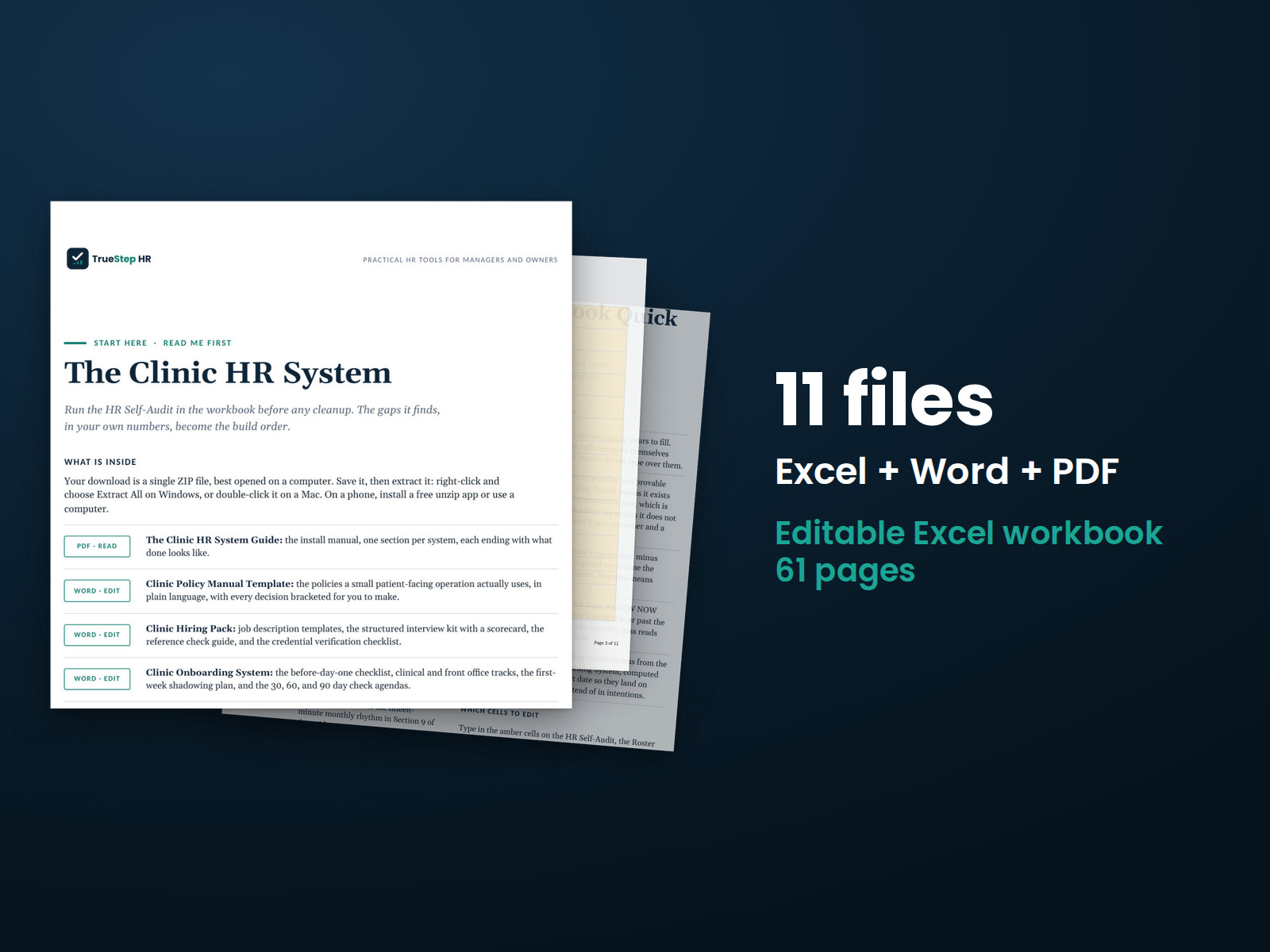
Real pages from the kit files. Example details are illustrative.
Clinic HR System
Most small clinics run their HR from the owner’s head: verbal policies, a personnel drawer, hiring by conversation, license dates in somebody’s memory. This kit is the paper layer, installed in one focused month: the files, the policy manual, the hiring pack, the onboarding tracks, and the trackers that keep it true, each one editable and each one written for a small patient-facing operation.
One-time purchase, no subscription. Instant download.
Built to the TrueStep HR standard
- The 12-page System Guide: the install manual, one section per system, from the employee files through the operating rhythm, each ending with what done looks like
- Clinic Policy Manual Template: fourteen plain-language policies with every decision bracketed, the state-specific lines flagged for attorney review, and a signed acknowledgment page, in Word
- Clinic Hiring Pack: job description templates for the core clinic seats, the structured interview kit with a scorecard, the reference check guide, and the credential verification checklist, in Word
- Clinic Onboarding System: the before-day-one checklist, clinical and front office week-one tracks, the 30, 60, and 90 day check agendas, and the completion record, in Word
- The Operations Workbook: the thirty-line HR self-audit, the credential roster with computed expiry flags and check dates, the attendance log, the coverage map, and a dashboard, in Excel or Google Sheets
The kit carries the documents and the trackers. The decisions in the brackets, and the attorney review that makes the policy manual yours, stay with you, and the guide is direct about both.
14-day money-back guarantee. If it does not help, email us and we refund you.
General information, not legal advice. Employment rules vary by state and by care setting; the guide flags the state-specific decisions and names the one step that converts the template into your policy, a review by an employment attorney before rollout. Decisions about any individual are made through your own channels and policies.
Not the right fit? Take the 60-second match.
Buying for clients or multiple entities? The White-Label tier is in the license.
Six working files, one install order
Run the self-audit cold, read the guide sections for your gaps, adapt the Word templates as each section calls for them, load the workbook, and book the fifteen-minute monthly rhythm. The Start Here maps the order.
Start Here
A one-page map of the kit and the install order: the twenty-minute self-audit first, so the gaps become your build order, then the guide, the templates, the workbook, and the rhythm.
The System Guide (12 pages)
Ten sections: why the paper layer decides the people problems, with the healthcare benchmark numbers; the employee file system; the policy manual and how to adapt it; hiring on structure; credentials and licensure as a system; onboarding as a system; attendance, time off, and coverage; the HR self-audit; the operating rhythm; and when to bring in help, including which pieces belong in front of a professional.
Clinic Policy Manual Template
Fourteen policies in plain language: the employment relationship and classifications, pay and timekeeping, schedules and swaps, attendance and call-outs, time off and leave, credentials, patient privacy, professional conduct, the respectful workplace, performance, safety, technology, and separation, with every decision bracketed, the state-specific lines flagged, and the acknowledgment page at the end.
Clinic Hiring Pack
Job description templates for the medical assistant, front desk coordinator, and clinical nurse seats; the structured interview kit with the opening, the scenario question shapes with worked examples per seat, and the scorecard; the reference check guide with the six questions; and the credential verification checklist that runs before the offer.
Clinic Onboarding System
The before-day-one checklist with owners, the day-one plan with the welcome script, clinical and front office week-one shadowing tracks with a demonstrable competency per day, the 30, 60, and 90 day check agendas with the rising bar, and the completion record that goes to the file.
The Operations Workbook
Seven tabs: a Start Here, the thirty-line HR Self-Audit with status, owner, and date per line, the Roster and Credentials sheet with computed days to expiry, the 60-day flag, and the onboarding check dates, the Attendance and Time-Off Log, the Coverage Map with computed qualified cover per seat, a computed Dashboard, and a Definitions reference. Works in Excel or Google Sheets.
The install, in the order the guide runs it
Files first, because everything writes into them. Policies second, because they settle the decisions. Then credentials, attendance, hiring, and onboarding, with the rhythm booked at the end. One focused month for most small operations.
Score the setup cold
The twenty-minute self-audit, before any cleanup: Yes, Partial, or No across all six systems. The gaps become the build order, and the dated audit becomes your baseline.
Install the files and the manual
One working file per person with the same six sections, sensitive material separated. Then the policy manual: the bracketed decisions made out loud, the attorney review, the huddle rollout, and the signed acknowledgment into every file.
Build the credential roster
Every license and certification with a source-verified expiry date. The sheet computes the days and flags anything inside 60 days; the monthly look takes five minutes.
Run the next hire on the system
The written job description, the same five scenario questions for every candidate, the scorecard, the references, the credential check before the offer, and the onboarding track from before day one through the 90-day close.
Book the rhythm
Fifteen minutes monthly on the dashboard, the audit re-run quarterly, one policy pass a year. Systems stay true because somebody looks at them on a schedule; the workbook is built to be that meeting’s agenda.
Consistency is what a team reads as fairness
A small clinic does not lose people over missing paperwork. It loses them over what the missing paperwork produces: decisions that vary by mood and by who asks, a first day nobody prepared, a license crisis nobody saw coming, and a manager buried in the resulting churn. The fix is a small set of decisions made once, written down, and applied evenly. That is what this kit installs.
The kit is honest about its edges
Most of a small clinic’s HR is squarely installable from this kit. Some pieces belong in front of a professional, and the guide marks each one instead of pretending otherwise.
Who does what
The kit, you, and your professionals each carry a specific part. Here is the split, stated plainly.
- The kit carries the documents; you carry the decisions. Every bracket in the policy manual is a decision only you can make, and the guide’s advice is to make them out loud, with the person who runs the schedule in the room.
- The kit structures the process; your professionals convert it. The attorney review is what turns the template into your policy, and the kit is built so you arrive at that review with the work already done.
- The kit holds the record; the rhythm keeps it true. Fifteen minutes a month on the dashboard is the difference between a system and a souvenir, and the guide’s last sections are built around exactly that.
Who it is built for
Who this kit fits, and where to go if that is not you.
Built for
- The clinic owner or administrator whose HR lives in their head, and who wants the files, the policies, and the trackers installed without hiring an HR department.
- The practice or office manager who inherited a drawer instead of a system, and needs the paper layer standing before the next hire, the next audit question, or the next license renewal.
- The home health or senior care operator whose team is growing past the point where memory and goodwill can referee schedules, time off, and credentials.
If you are looking for
- The manager’s own capability, the coverage moves, the conversations, and the staffing scoreboard, rather than the clinic’s documents. The Clinic Manager Field Guide develops exactly that.
- The dental-specific document set, with dental roles, chairside onboarding, and practice presets. The Dental Practice HR System carries that.
- One specific disagreement you have been sitting on, rather than the whole paper layer. The Conflict at Work Playbook runs that conversation start to finish.
Before you buy
What format are the files and can I edit them?
Is this legal advice? Will it make my clinic compliant?
How is this different from the Clinic Manager Field Guide?
Does this fit home health or senior care, or just clinics?
Do I need to take the free Clinic Manager Assessment first?
What is the refund policy?
What happens after I buy?
Can I expense this purchase to my business?
Most customers buy TrueStep HR tools for business use, and a tool you use for work often qualifies as a deductible business expense. Whether it does for you depends on your situation, so confirm with your accountant or tax professional. Your receipt arrives by email at checkout and works as documentation.
The 6 red flags to check before you discipline or fire someone
A five-minute screen to run before you act. Free PDF, sent to your inbox. Unsubscribe anytime.
This kit is built on the published research. Read the basis yourself:
What buyers say
Get the clinic’s HR out of your head
The files, the policy manual, the hiring pack, the onboarding tracks, and the trackers that keep it true, installed in one focused month, in files you keep.