Compliance pack

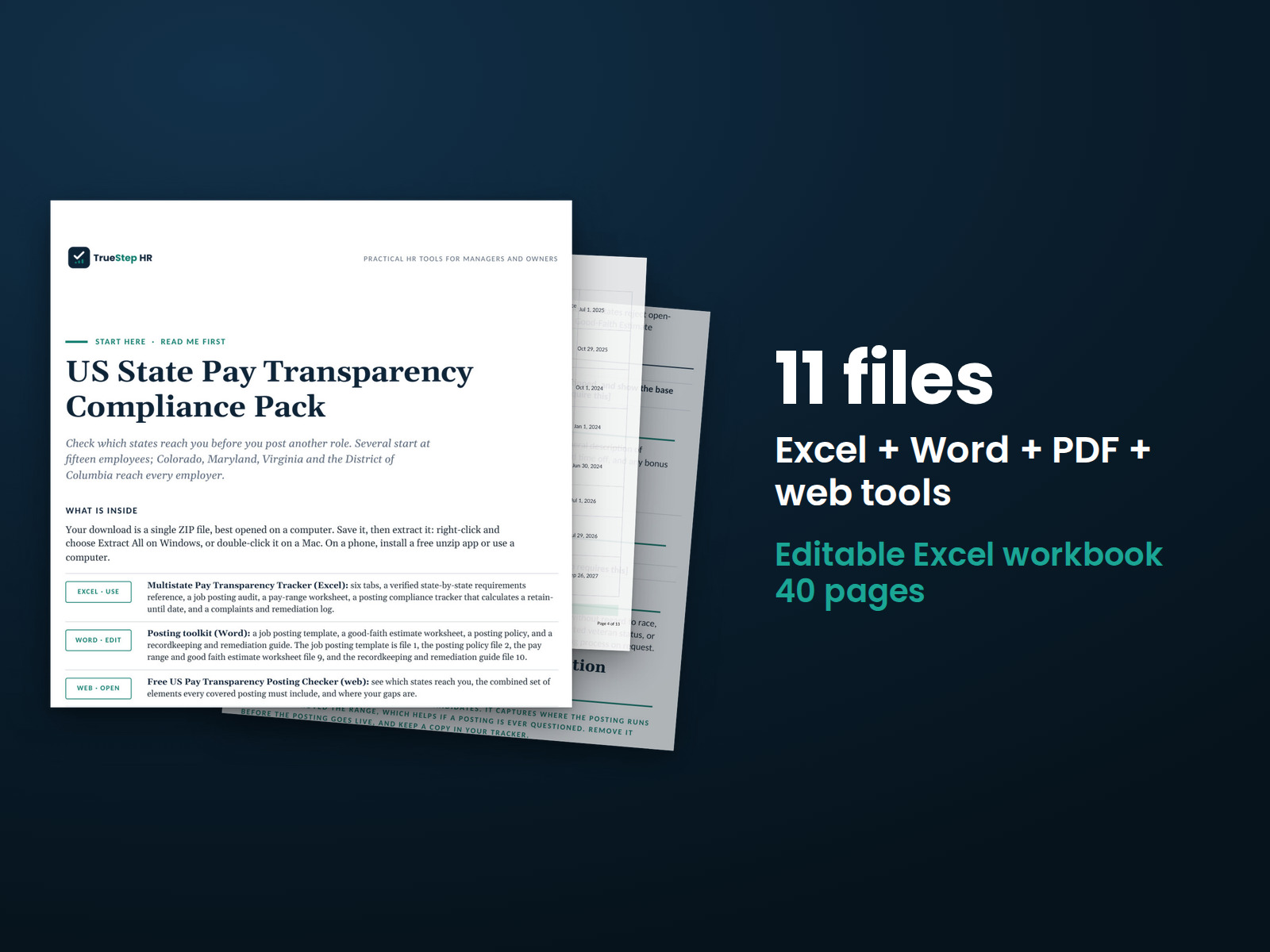
US State Pay Transparency Pack

Post job openings that meet every state pay-range rule that reaches you. Set a defensible good-faith range, carry the right elements in each state's postings, keep the records, and track complaints, all in one place.

$129USD

One-time purchase, no subscription. Instant download.

Built by expert HR practitioners and leaders

  • Multistate job posting template with the pay range, the basis for it, and the benefits line where a state requires one, plus a pre-publish checklist
  • Good-faith range worksheet that builds a defensible range from market data and your internal pay, and records how you got there
  • Six-tab tracker with a verified state-by-state reference, a posting audit, a range worksheet, a compliance tracker, and a complaints log
  • Retain-until dates calculated: log each posting and the tracker dates how long to keep the record
  • Posting policy and remediation guide: the policy for whoever writes postings, and the steps if a complaint or notice arrives
  • Free posting checker and Start Here guide: see which states reach you and what every covered posting must include

The pack organizes the posting work and keeps the record. It does not determine that a posting complies and does not replace counsel review.

One-time purchase Instant download Editable files 14-day guarantee

Templates, a tracker, and general business information for planning, not legal or tax advice. State and local rules differ and change, so confirm the current requirements for each state where you post and take edge cases to employment counsel.

Not the right fit? Take the 60-second match.

Last reviewed June 2026

Buying for clients or multiple entities? The White-Label tier is in the license.

One-time purchaseNo subscription
Instant downloadFiles you keep
Editable filesExcel, Word, PDF
14-day guaranteeMoney back
Secure checkoutSSL encrypted
What you get

Seven files that take a posting from draft to documented

A template you publish from, a worksheet that sets the range, a policy for the people who write postings, a tracker that runs the dates, and a checker before anything goes live. Built to be used together on every posting.

PDFStart here

Start Here

What each file does, the order to use them, and which states reach you in plain language. One page, read it first.

DOCXWord + PDF

Multistate Job Posting Template

A ready-to-fill posting that carries a pay range, the basis for it, and a benefits line where a state requires one, with coaching notes on each field and a pre-publish checklist.

DOCXWord + PDF

Pay Range and Good-Faith Estimate Worksheet

Build a defensible range from market data and your internal pay, keep the width sensible, and record how you arrived at it, so the number holds up if it is ever questioned.

DOCXWord + PDF

Pay Transparency Posting Policy

A short internal policy for the people who write and approve postings, so the required lines go in every time and not only when someone remembers to add them.

DOCXWord + PDF

Recordkeeping and Remediation Guide
What to keep and for how long, and the steps to take if a complaint or an agency notice arrives, written so you act in order instead of improvising under pressure.

XLSXExcel

Multistate Pay Transparency Tracker

Six tabs: a verified state-by-state requirements reference, a job posting audit, a pay-range worksheet, a posting compliance tracker that dates how long to keep each record, and a complaints and remediation log. Works in Excel or Google Sheets.

HTMLWeb tool

US Pay Transparency Posting Checker

See which states reach you, the combined set of elements every covered posting must include, and where your gaps are. It runs locally in any browser, uploads nothing, and its result is a self-assessment, not a compliance determination.

How it works

The method in the order a posting runs

States first, pay second, then the posting and the records. The pack drafts and documents; counsel makes the close calls.

STEP 01

Confirm which states reach you

Posting rules start at a size threshold in most states, at 15 or more employees in several, and reach all employers in Colorado, Maryland, and the District of Columbia. The free checker shows where you stand and what your postings must carry.

STEP 02

Set a defensible range

Use the good-faith estimate worksheet to build a range from market data and your internal pay, keep the width sensible, and record how you arrived at it. A range that ignores what you already pay creates an internal-equity problem of its own.

STEP 03

Build the posting and adopt the policy

Draft from the job posting template so every posting carries a range, a basis, and a benefits line where a state requires it, then put the posting policy in front of the people who write and approve postings.

STEP 04

Track and keep records

Log each posting and its retain-until date in the tracker, record any complaint or agency notice and how you resolved it, and where a posting is close or questioned, confirm the current rule for that state and take it to qualified employment counsel.

The standard

Built on the rules in effect now and honest about its limits

Pay-range rules differ state by state and change often, so the pack is careful where it counts and clear about where counsel takes over.

The rules reach more than the posting itself: a defensible range, the records you keep, and how you answer a complaint are all in scope.
Never a stand-in for legal advice. The templates and the tracker mark the legal checkpoints, from a state's coverage threshold to what a covered posting must include, and tell you when to route the call to employment counsel.
The reference checked against current sources. The state-by-state requirements reflect the pay-transparency posting rules in effect in mid-2026, framed as a reference to confirm, not a guarantee.
A worked example to follow. The tracker opens on a filled-in posting, so you see the audit, the range, and the retain-until date working before you log your own.
Dated and reviewable. Every file carries a last-reviewed date, the tracker keeps the record the rules expect you to hold, and the complaints log shows how each matter was handled.

The pack tells you when to call a lawyer

Posting rules look mechanical until a case sits near a line. The checkpoints below are marked in the templates and the tracker, so you slow down before publishing or correcting anything. Advice early is far cheaper than a complaint later.

A role posted across several states with different rules Pay set as commission, a bonus, or a wide band Whether a remote role triggers a particular state's rule A benefits-description requirement in a state that has one A live posting that already breaks a state's rule A complaint or an agency notice about a posting

Who does what

A compliant posting splits the work between you, the pack, and your counsel. Here is the split, stated plainly.

  • The pack carries the required lines; you make the posting yours. The template holds the range, the basis, and the benefits line. The role, the pitch, and what it pays stay your call.
  • The pack structures the range; you set the pay. The worksheet builds a good-faith range and records how you got there. The number itself is a business decision.
  • The pack maps the states; counsel rules on the gray areas. The reference shows who is covered and what each posting carries. Whether a particular remote role triggers a given state is a legal call.
  • The pack dates the records; you keep them. The tracker calculates how long to hold each posting. Keeping the file, and producing it if anyone asks, is on you.
  • The pack keeps the record, and the record is the point. A logged posting, a defensible range, and a complaints log are the difference between a clean answer and a scramble.
Is this for you

Who it’s built for

Who this fits, and where to go if that’s not you.

Built for

  • A US employer hiring across more than one state that needs every posting to meet the rule that reaches it, without a lawyer on each one.
  • An HR team of one or a recruiter who writes the postings and needs the required elements, a defensible range, and the records handled in one place.
  • A company that posts remote roles and is not sure which states' rules apply, and wants the coverage question answered before it posts.

If you are looking for

Questions

Before you buy

What format are the files and can I edit them?
One Excel tracker, four Word templates that also ship as PDFs, a Start Here PDF, and a web checker that opens in any browser. The tracker works in Excel or Google Sheets, everything is editable, and the files are yours to keep. The checker runs locally and uploads nothing.
Is this legal advice?
No. It is general information and a self-review structure for planning. The pack marks where to bring in employment counsel, and it does not determine that any posting complies. Take edge cases, and anything already live that breaks a rule, to counsel before you act.
Which states does it cover?
The state-by-state reference covers the pay-transparency posting rules in effect in mid-2026, including California, Colorado, Washington, New York State, Illinois, Minnesota, New Jersey, Vermont, Massachusetts, Maryland, Hawaii, and the District of Columbia, with Virginia and Maine taking effect in 2026. Several cities and counties have their own rules. Confirm the current rule for each place you post.
How do I know which states reach my company?
Posting rules start at a size threshold in most states, at 15 or more employees in several, and reach all employers in Colorado, Maryland, and the District of Columbia. The free checker and the Start Here walk through it, and a remote role can pull in more than one state, so confirm coverage before you post.
What has to be in a posting?
It varies by state. Most covered postings need a pay or salary range set in good faith, and several states also require a general description of benefits and other compensation. The template carries the lines and the reference shows which states require what, so confirm the current rule for the states where you post.
What is a good-faith range?
A range you reasonably expect to pay for the role, built from market data and your internal pay, not a band so wide it means nothing. The worksheet helps you build one and record how you arrived at it, which is what matters if a range is ever questioned.
What do we have to keep and for how long?
Recordkeeping periods differ by state, so the tracker dates a retain-until for each posting and the recordkeeping guide explains what to hold. Keep the posting, the basis for the range, and how you handled any complaint, and confirm the period for the states that apply to you.
Will it stay current as the rules change?
Each file carries a last-reviewed date so you can see how current it is, and meaningful updates are released as the rules change. State rules move quickly and new ones take effect through 2026, so check the date before you lean on a requirement.
What is the refund policy?
Digital products are covered by a 14-day money-back guarantee. See the refund policy for the full terms.
What happens after I buy?
Checkout delivers an instant download link, and a receipt with the same link arrives by email. Open the Start Here page first; it tells you the order to work in. If a file gives you trouble, email support@truestephr.com.
Can I expense this purchase to my business?

Most customers buy TrueStep HR tools for business use, and a tool you use for work often qualifies as a deductible business expense. Whether it does for you depends on your situation, so confirm with your accountant or tax professional. Your receipt arrives by email at checkout and works as documentation.

Free guide

The 6 red flags to check before you discipline or fire someone

A five-minute screen that catches the most common and most expensive people-decision mistakes before they happen. Free PDF, sent to your inbox. Unsubscribe anytime.

Get the pack

Post it right in every state that reaches you

The required lines built into the template, a defensible range you can show your work on, and a retain-until date on every posting.

$129
One-time purchase, no subscription

Templates and self-review tools for planning, not legal or tax advice. Last reviewed June 2026.