
Personal development kit

Clinic Manager Field Guide

A clinic that cannot hold its people cannot hold its schedule. This kit works on exactly that: the working manual for a schedule that survives the call-out, hiring that holds through the first year, problems raised while they are small, and a staffing scoreboard that wins the budget conversation, built on the published research behind the free Clinic Manager Assessment and matched to its four areas.

$69USD

One-time purchase, no subscription. Instant download.

Built to the TrueStep HR standard

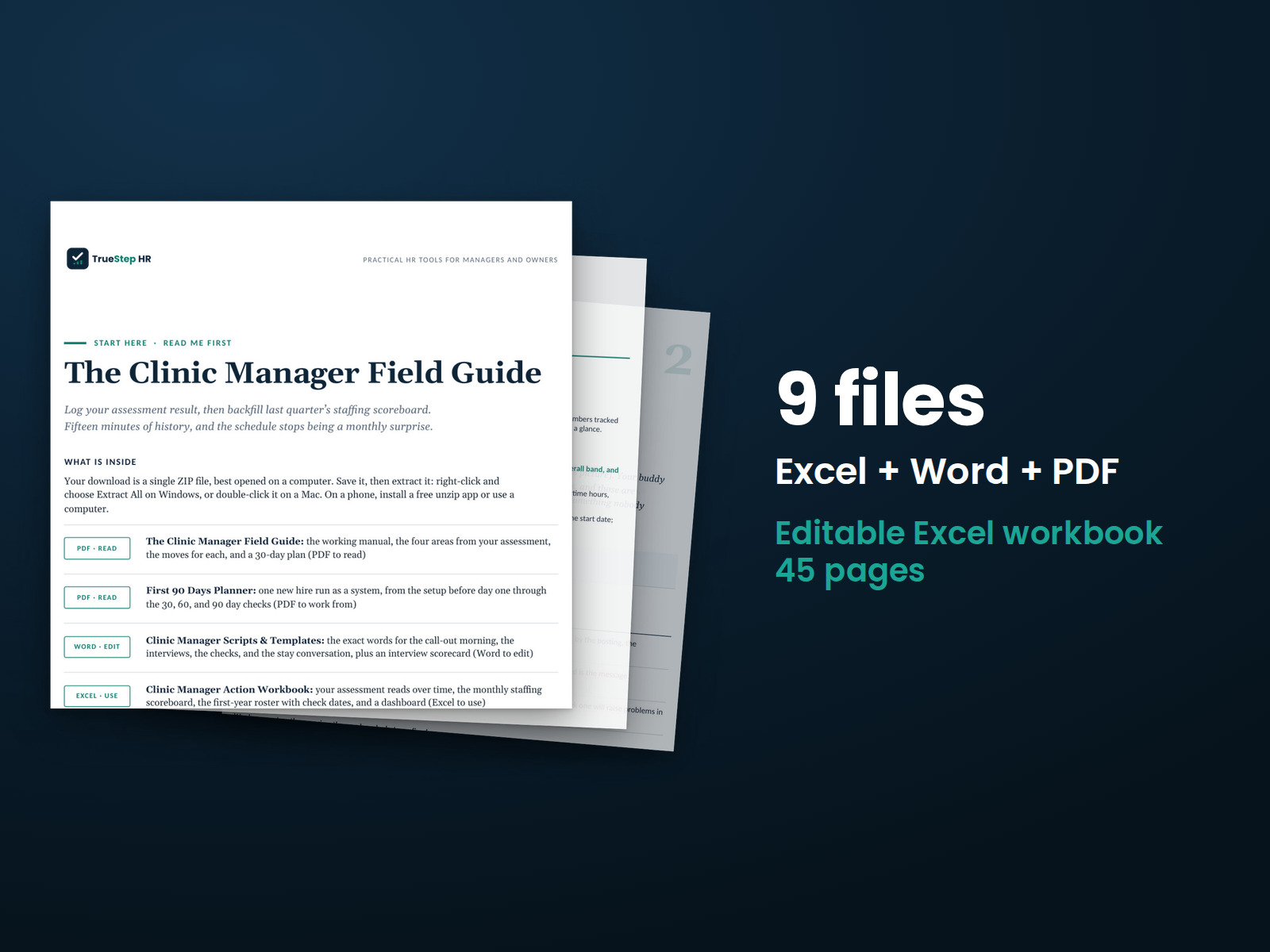
  • The 12-page Field Guide: what the seat costs, with the healthcare benchmark numbers, how to read your assessment result and its gap read honestly, a chapter of moves for each of the four areas, the first 90 days of a new hire, the traps, and a 30-day plan
  • The First 90 Days Planner: one new hire run as a system, the setup before day one, the welcome drafted word for word, the week-one check, and the 30, 60, and 90 day conversations
  • Clinic Manager Scripts and Templates: eight verbatim scripts, the call-out morning, the repeat call-out conversation, the structured interview, the checks, the stay conversation, plus an interview scorecard and the three-check agenda in Word
  • The Action Workbook: every assessment read logged over time, the five staffing numbers tracked monthly with computed rates, the first-year roster with computed check dates, and a dashboard, in Excel or Google Sheets

The kit gives you the systems, the words, and the scoreboard. The judgment calls in the clinic stay yours, and it names when a staffing problem is structural instead of a skills problem.

14-day money-back guarantee. If it does not help, email us and we refund you.

One-time purchase Instant download Editable files

A personal development tool. The assessment reads are your own scenario play and self-view, never a measure of any other person, and nothing in this kit belongs in a hiring, selection, or evaluation decision about any individual. The interview scorecard structures your process; the decisions stay yours, made through your own channels.

Not the right fit? Take the 60-second match.

Buying for clients or multiple entities? The White-Label tier is in the license.

One-time purchaseNo subscription
Instant downloadFiles you keep
Editable filesExcel, Word, PDF
14-day guaranteeMoney back
Secure checkoutSSL encrypted
What you get

Four working files, built to be used together

Read the Field Guide chapter for your weakest assessment area, backfill the scoreboard in the Workbook, run your next hire through the Planner, and open the Scripts when the moments come. The Start Here maps the order.

PDFStart here

Start Here

A one-page map of the kit and the order to use it: Field Guide first, starting with your weakest area, then the workbook scoreboard backfilled for last quarter, then your next hire run through the planner, then the scripts for the moments in between.

PDFRead first

The Field Guide (12 pages)

Ten sections: what the seat costs, with the healthcare benchmark numbers; reading your assessment result, including the gap read between your self-view and your scenario play; a chapter of moves for each of the four areas, Coverage and Scheduling, Hiring and First-Year Retention, Performance and Conflict, and Running the Numbers; the first 90 days of a new hire; the 30-day plan; the six traps; and when a staffing problem is structural, with how to take it upward in dollars.

PDFRun the hire

The First 90 Days Planner (4 pages)

One new hire, start to finish: the before-day-one setup with the buddy named and the checks booked, the day-one welcome drafted word for word, the end-of-week-one check that finds the mis-set expectation, and the 30, 60, and 90 day conversations with the early warning signs and the stay conversation drafted in advance.

DOCXWord

Clinic Manager Scripts and Templates

Eight scripts with the words close to verbatim: the call-out morning, the repeat call-out conversation, opening the structured interview, the scenario question, the day-one welcome, the day-30 check, the performance conversation, and the stay conversation. Plus the structured interview scorecard and the three-check agenda.

XLSXExcel

The Action Workbook

Six tabs: a Start Here, the Assessment Log that holds every read and gap read over time, the Staffing Scoreboard with the five monthly numbers and computed rates, the First-Year Roster with computed 30, 60, and 90 day check dates, a computed Dashboard, and a Definitions reference. Works in Excel or Google Sheets.

How it works

The method, in the order the work runs

Read your management honestly, put the numbers on a scoreboard, install the coverage systems, run the next hire properly, and re-check after a month. The kit structures each step; the judgment in the clinic stays yours.

STEP 01

Read the read

Take the free Clinic Manager Assessment, log the bands and the gap read in the workbook, and take the gap read seriously: most clinic managers were promoted for clinical excellence, and the research finds that group judges itself on the standard it knows rather than the one the seat is scored on.

STEP 02

Backfill the scoreboard

Fifteen minutes: last quarter of exits, first-year exits, open-shift days, days to fill, and overtime hours. One of the numbers will surprise you, and that number is usually where the work starts.

STEP 03

Install the coverage systems

The coverage map, the call-out protocol, and the swap rule, from the Coverage and Scheduling chapter. These buy back the hours everything else in the kit is made of.

STEP 04

Run the next hire as a system

The structured interview with the scorecard, then the Planner from before day one through the 90-day close, with every check booked at the offer. The first year is the window you control, and the planner is that window run on purpose.

STEP 05

Re-check and keep it

Re-run the assessment at day 30 and log it next to the first read. The honest test is not the band; it is whether the scoreboard is moving and the checks are happening on their dates. The workbook holds the trend.

The standard

Retention is management, and management is learnable

The expensive staffing losses follow a pattern: the strongest clinician promoted without the systems, every gap absorbed personally, hiring rushed under coverage pressure, and new hires gone before the ramp closes. The fix is not a personality change. It is a small set of systems, run deliberately, with the record kept. That is what this kit operationalizes.

A clinic that cannot hold its people cannot hold its schedule, and a clinic that cannot hold its schedule cannot see its patients. The staffing chain gets decided in the manager’s seat, and every move in this kit works one of its levers.
The exits are voluntary and front-loaded. In the reference research, 94.9% of healthcare separations were voluntary and 29.5% of new hires left inside their first year. Both numbers live inside the manager’s reach, which is why the kit spends a full chapter and the whole planner on the first year.
Structured selection has numbers on it. The reference meta-analysis found structured, talent-based selection beating performance-and-tenure selection by 21% on revenue and 32% on profit per manager. The interview scorecard in this kit is that finding, made usable on a Tuesday.
The self-view gap is the interesting part. Most clinic managers were promoted for frontline excellence, and the free assessment reads your scenario play against your self-view per area. The workbook tracks whether the two converge, because a calibrated read is what makes judgment reliable under load.

The kit names what is not a management-skill problem

Most clinic staffing problems are squarely yours to work. Some only look like skills problems, and the kit marks them, so they get taken upward with numbers instead of absorbed downward in goodwill.

Pay clearly below the local market keeps surfacing in stay conversations no manager can fix alone, and the kit shows how to take it to the owner in dollars A staffing model that needs more seats than the budget holds will keep breaking the schedule regardless of protocol quality, and the scoreboard is how that case gets made Formal workplace concerns and anything a policy or a professional should handle go through your practice’s own channels, not through a peer conversation from a kit A problem that belongs to someone above you uses the same conversation shape with a different risk calculus, and the Field Guide spells out the difference

Who does what

The kit, you, and the debrief each carry a specific part. Here is the split, stated plainly.

  • The kit carries the systems; you carry the follow-through. The coverage map, the scorecard, the checks, and the scoreboard organize the work. The conversation held on its date and the bar held under coverage pressure are the parts only you can run, and they are what move the numbers.
  • The kit scripts the openings; the listening is the skill. The scripts organize what you say. What you do with what comes back, the Monday pattern, the workload honesty, the stay conversation answer, is the craft, and the Field Guide trains exactly that.
  • The kit holds the record; the record keeps you honest. Reads logged over time, a scoreboard with the trend, and check dates that compute from the start date are what separate a managed clinic from a well-intentioned one.
  • When you want a senior read on the live one, the Debrief carries it. Thirty minutes with Greg Best, SPHR, on your assessment result and the staffing situation in front of you, ending in what to do first.
Is this for you

Who it is built for

Who this kit fits, and where to go if that is not you.

Built for

  • The practice or clinic manager whose schedule keeps breaking, whose new hires keep leaving, or whose week keeps disappearing into coverage, and who wants the systems that stop it.
  • The strong clinician newly promoted into the seat who just ran the free Clinic Manager Assessment and wants to act on the result, especially a Reactive area or a Blind spot gap read.
  • The practice owner or administrator equipping a manager whose staffing losses keep landing on the budget three hires later than they should have.

If you are looking for

  • The full HR document set for a dental practice, policies, hiring paperwork, and onboarding, rather than the manager’s own capability. The Dental Practice HR System carries that.
  • The wider emotional skill behind the moments, reading the room, managing your own reactions, rather than the clinic systems. The EQ at Work Field Guide is built for that.
  • The conflict system on its own, for one specific disagreement you have been sitting on. The Conflict at Work Playbook runs that conversation start to finish.
Questions

Before you buy

What format are the files and can I edit them?
The Field Guide, the First 90 Days Planner, and the Start Here are print-ready PDFs, the Action Workbook is an Excel file that also works in Google Sheets, and the Scripts and Templates are an editable Word file. Everything is yours to keep and adapt.
Do I need to take the free Clinic Manager Assessment first?
It is the natural starting point, because the Field Guide chapters map to its four areas and the workbook logs its reads over time. But the kit stands on its own: if you already know the schedule keeps breaking or the new hires keep leaving, start with that chapter and run its first two moves this week.
Does this only apply to medical clinics?
It is written for the person who manages a patient-facing team: medical, dental, veterinary, therapy, or any practice where the schedule is the product. The scenarios use clinic language, and the systems, the coverage map, the structured interview, the three checks, the scoreboard, run the same in any of them.
Can I use this for hiring or performance reviews?
No. This is a personal development tool. The assessment reads are your own scenario play and self-view, never a measure of any other person, and nothing in this kit belongs in a hiring decision or an individual performance evaluation. The interview scorecard structures your questions and note-taking; the judgment and the decision stay yours, made through your own process.
How is this different from a free article about managing a clinic?
An article tells you retention matters. This is the operating system: the specific moves per area with the words to say, one new hire run as a system from before day one through day 90, eight verbatim scripts with a structured interview scorecard, and a workbook that tracks the five staffing numbers and computes the check dates. It is also honest about the hard parts, like what to do when the problem is structural instead of a skills problem.
What is the refund policy?
Digital products are covered by a 14-day money-back guarantee. See the refund policy for the full terms.
What happens after I buy?
Checkout delivers an instant download link, and a receipt with the same link arrives by email. Open the Start Here page first: it maps the four files and the order to use them, starting with your weakest assessment area. Questions? Email support@truestephr.com.
Can I expense this purchase to my business?

Most customers buy TrueStep HR tools for business use, and a tool you use for work often qualifies as a deductible business expense. Whether it does for you depends on your situation, so confirm with your accountant or tax professional. Your receipt arrives by email at checkout and works as documentation.

Free guide

The 6 red flags to check before you discipline or fire someone

A five-minute screen to run before you act. Free PDF, sent to your inbox. Unsubscribe anytime.

The method behind this

This kit is built on the published research. Read the basis yourself:

Get the kit

Run the clinic on systems instead of goodwill

The moves per area, one new hire run as a system, the scripts for the moments in between, and the scoreboard that keeps it honest, in files you keep.

$69
One-time purchase, no subscription. Instant download.