HR calculator

HR Staffing Ratio Calculator

See how your HR team stacks up against the typical ratio for your size. Enter your headcount and HR staff, and the workbook returns your HR-to-employee ratio, the gap to a target you set, and what your HR function costs per employee.

$24USD

One-time purchase, no subscription. Instant download.

Built by expert HR practitioners and leaders

  • Your HR-to-employee ratio against your size: headcount and HR staff turned into HR staff per 100 employees, with the typical low and high for your size band alongside, so you see at a glance whether HR is stretched, about right, or richly resourced
  • The gap to a target you set: the HR headcount your target ratio implies and how far your current team sits from it, positive to add and negative to trim, so the staffing case is a number rather than a feeling
  • The cost of your HR function per employee: your HR headcount turned into a cost per person on the payroll, now and at your target, with what the move would add or save each year, so you can weigh adding staff against HR technology
  • Sourced benchmarks by organization size: a Benchmark tab with published HR-to-employee ratios from SHRM, Bloomberg Law, ADP, and Indeed, and a note on why the surveys differ, so the comparison holds
  • A working file you keep: a pre-filled worked example, a board-ready one-page Summary, your numbers saved, and the method documented in plain English, not a one-time screen

The workbook computes from the numbers you enter. Your headcount, HR staff, target ratio, and average HR salary are yours to set.

One-time purchase Instant download Editable files 14-day guarantee

Planning estimates and general business information, not legal or tax advice. The right ratio depends on your industry, your HR technology, and how strategic HR needs to be, so treat the benchmarks as a starting point, not a rule. Count your HR staff the way the benchmarks count them so the comparison holds.

Not the right fit? Take the 60-second match.

Last reviewed June 2026

One-time purchaseNo subscription
Instant downloadFiles you keep
Editable filesExcel, Word, PDF
14-day guaranteeMoney back
Secure checkoutSSL encrypted
What you get

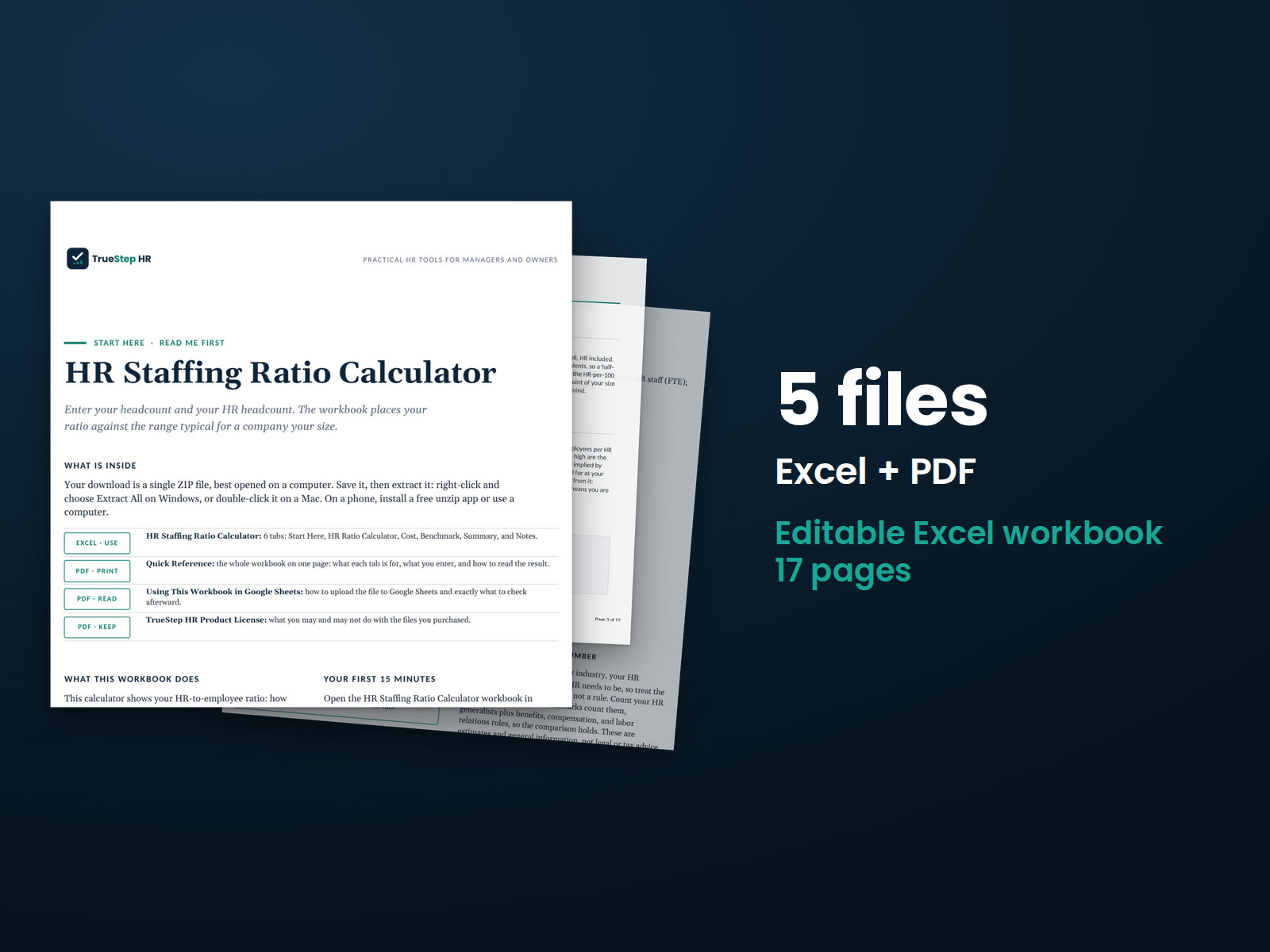
One Excel workbook that turns your headcount and HR staff into a benchmarked ratio

A working model, not a blank sheet. You enter your headcount, your HR staff, and a target, and the workbook returns your ratio against the typical range for your size and what HR costs per employee. It opens on a worked example so the logic is clear before you change anything.

XLSXExcel + Sheets

HR Staffing Ratio Calculator

Enter your total headcount and your current HR staff in full-time equivalents, then a target ratio. The workbook returns your HR staff per 100 employees, the employees per HR FTE, the typical low and high for your size band, the HR headcount your target implies, and the gap between your current team and that target.

XLSXBuilt in

A cost-per-employee view, a board-ready summary, sourced benchmarks, and the method in plain English

A Cost tab turns your HR headcount into a cost per employee using an average fully loaded HR salary, now and at your target, and shows what the move would add or save. A one-page Summary gives the headline read, a Benchmark tab holds published ratios by organization size from SHRM, Bloomberg Law, ADP, and Indeed, and the Notes tab documents how each number is built.

How it works

Three steps from headcount to a benchmarked HR ratio

You enter your organization, read the ratio against your size, and cost the move. The workbook does the rest.

STEP 01

Enter your headcount and HR staff

Fill the amber cells: total employees including HR, your current HR staff in full-time equivalents so a half-time person counts as 0.5, and a target ratio. The worked example runs 150 employees with 2 HR staff, change it to your own numbers. Count HR the way the benchmarks count it, generalists plus benefits, compensation, and labor relations roles, not payroll.

STEP 02

Read your ratio against your size

The workbook returns your HR staff per 100 employees and the employees per HR FTE, with the typical low and high for your size band alongside. The HR FTE implied by your target and the gap to it show how far your current team sits from where you want to be.

STEP 03

Cost the move and roll it up

The Cost tab turns your HR headcount into a cost per employee now and at your target, with what the move would add or save each year, so you can weigh adding staff against HR technology. The Summary rolls the ratio and the cost up for a leadership conversation.

The standard

There is no single right HR ratio so read yours against your size first

Two habits get HR staffing wrong. The first chases one headline number, when the right ratio moves with organization size, industry, and HR technology. The second compares HR teams that are counted differently, since some surveys include payroll and some do not, which makes the numbers look further apart than they are. A model that puts your ratio next to the published range for your size, on a consistent count, gives a read you can plan against.

There is no single correct HR-to-employee ratio. The most-cited figure on the Benchmark tab is SHRM’s, near 1.7 HR staff per 100 employees; Bloomberg Law lands near 1.5 and broad surveys average closer to 1.4, while ADP and Indeed report about 2.5 because they count a wider set of HR roles, including payroll. The ratio also runs higher in smaller organizations, where a minimum viable HR function covers everything regardless of scale, and in regulated, people-intensive sectors. Read your ratio against the band for your size on a consistent count first, then adjust for your industry and how strategic HR needs to be.
Your ratio against your size band tells the story. In the worked example 2 HR staff for 150 employees is 1.3 per 100, against a typical 1.7 to 2.5 for a 100 to 250 person organization, so HR sits below the range, which often shows up as slow response times and gaps in compliance. Above the range can mean rich resourcing or a high-touch industry. Read the band first, then adjust.
The gap to target turns a feeling into a number. A target of 1.8 per 100 implies 2.7 HR staff at 150 employees, a gap of 0.7 above the current 2, so the staffing case is a specific number rather than an argument. Set the target to the midpoint of your size band if you have none in mind.
Cost per employee is how you weigh staff against technology. In the example HR runs $1,133 per employee now and $1,530 at the target, a change of about $59,500 a year. The figure runs higher in small organizations, where a fixed HR team is spread over fewer people, and falls with scale, so use it to compare adding HR headcount with investing in HR technology or outsourcing.
Is this for you

Who this calculator fits and where to go if that is not you

It benchmarks your HR team against the typical ratio for your size and puts a cost per employee on the function, with a board-ready summary. For the cost of any role, a pay range, or the cost of turnover, the right tool is next to it.

Built for

  • An HR leader sizing the case for HR headcount or HR technology who wants the ratio against the band for their size, not one headline number.
  • A founder, COO, or finance partner deciding whether HR is staffed about right as the company grows, with a cost per employee on the function.
  • An HR or operations partner comparing the HR team to published ranges on a consistent count, then adjusting for industry and HR technology.

If you are looking for

  • The fully loaded ANNUAL cost of any role built component by component, rather than the cost of the HR function per employee. The Employee Cost Calculator covers that.
  • Pay ranges, midpoints, and where an HR salary sits in a band. The Salary Band Builder builds those.
  • What turnover costs you when HR or any team loses people. The Cost of Turnover Calculator sizes it.
Questions

Before you buy

What format is it and can I edit it?
It is one Excel workbook that also works in Google Sheets. Every input and formula is editable, and the file is yours to keep. Change your headcount, your HR staff, the target ratio, and the average HR salary, add notes, and duplicate the file to rerun the numbers as you grow.
How accurate is the result?
The ratio itself is exact arithmetic: HR staff divided by total employees, times 100. What it means depends on how you count HR and on your size, industry, and HR technology, so the Benchmark tab gives published ranges by organization size and a note on why the surveys differ. Count HR the way the benchmarks count it, generalists plus benefits, compensation, and labor relations, not payroll, so the comparison holds. Every figure foots to your inputs.
How is this different from the free calculator?
The free calculator gives you a quick ratio on screen. The workbook is for when you need to keep and work that number. You own the file in Excel and Google Sheets, so your numbers stay saved and every formula is open to edit and audit. It adds the gap to a target you set, a Cost tab that turns your HR headcount into a cost per employee now and at your target, a one-page summary built for a board or leadership review, and a Benchmark tab with published ratios by organization size from SHRM, Bloomberg Law, ADP, and Indeed. The free tool answers where you stand; the workbook is the model you use to size the staffing case.
How should I count HR staff?
Count your HR headcount in full-time equivalents, so a half-time HR person counts as 0.5. Include HR generalists plus benefits, compensation, and labor relations roles, and leave payroll out, because that is how the published benchmarks count HR. If you count payroll in, your ratio will look higher than the surveys that exclude it, and the comparison will not hold.
What is the refund policy?
Digital products are covered by a 14-day money-back guarantee. See the refund policy for the full terms.
What happens after I buy?
Checkout delivers an instant download link, and a receipt with the same link arrives by email. Open the workbook in Excel or Google Sheets, enter your headcount and HR staff, and read the ratio. If a file gives you trouble, email support@truestephr.com.
Can I expense this purchase to my business?

Most customers buy TrueStep HR tools for business use, and a tool you use for work often qualifies as a deductible business expense. Whether it does for you depends on your situation, so confirm with your accountant or tax professional. Your receipt arrives by email at checkout and works as documentation.

Free guide

The 6 red flags to check before you discipline or fire someone

A five-minute screen that catches the most common and most expensive people-decision mistakes before they happen. Free PDF, sent to your inbox. Unsubscribe anytime.

Get the calculator

See where your HR team stands

Enter your headcount and HR staff, and the workbook returns your ratio against the typical range for your size, the gap to target, and the cost per employee, in a file you keep.

$24
One-time purchase, no subscription

Planning estimates and general business information, not legal or tax advice. Last reviewed June 2026.