HR calculator

Span of Control Calculator

See how many direct reports each manager carries, on average, and what reshaping your structure would do to management cost. Enter your headcount and manager count, and the workbook returns your average span, your org layers, the managers a target span would call for, and the dollar change from getting there.

$24USD

One-time purchase, no subscription. Instant download.

Built by expert HR practitioners and leaders

  • Your span of control, read against your structure: the average direct reports per manager, the individual contributors, the managers as a share of the workforce, and a rough layer count, every formula visible and editable in Excel or Google Sheets
  • The cost of reshaping spans: set the extra pay a manager carries over an individual contributor, and the workbook returns your management premium now, the premium at a target span, and the dollar change from getting there
  • A target span, sized in managers: set the reports per manager you want to plan toward, and see how many managers that calls for and the gap to your count today
  • Sourced span benchmarks: typical spans by the nature of the work, the McKinsey archetypes from player-coach to coordinator, with the current Gallup, Pave, and BLS figures cited, to sense-check your target
  • A working file you keep: a pre-filled worked example, your numbers saved, and the method documented in plain English, not a one-time screen

The workbook computes from the numbers you enter. The headcount, the manager count, the target span, and the manager pay premium are yours to set.

One-time purchase Instant download Editable files 14-day guarantee

Planning estimates and general business information, not legal or tax advice. The result rests most on a clean count of who manages people and the pay premium you set, so define a people-manager as anyone with at least one direct report, and treat the figures as a way to size your structure and its cost, not a precise org chart or a layoff plan.

Not the right fit? Take the 60-second match.

Last reviewed June 2026

One-time purchaseNo subscription
Instant downloadFiles you keep
Editable filesExcel, Word, PDF
14-day guaranteeMoney back
Secure checkoutSSL encrypted
What you get

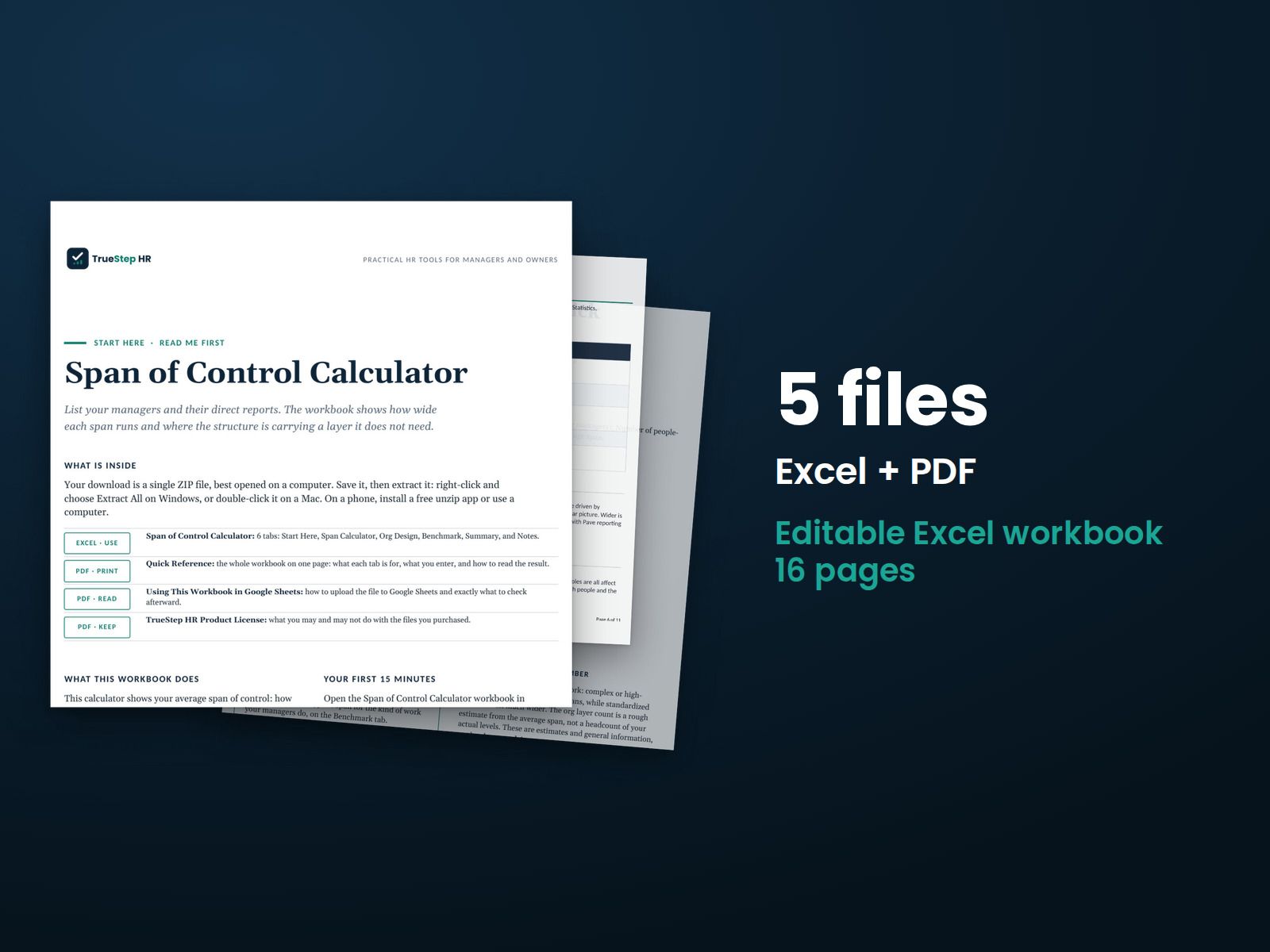
One Excel workbook that turns a headcount and a manager count into your span, your layers, and the cost of reshaping them

A working model, not a blank sheet. You enter the headcount and the managers, the workbook returns the structure and what a target span would cost or save, and it opens on a worked example so the logic is clear before you change anything.

XLSXExcel + Sheets

Span of Control Calculator

Enter your total headcount including managers, the number of people-managers, and a target span. The workbook returns your average span of control, the individual contributors, the managers as a share of the workforce, the estimated org layers, the managers a target span would call for, and the gap to your count today.

XLSXBuilt in

An org-design and cost tab, a board-ready summary, sourced benchmarks, and the method in plain English

An Org Design and Cost tab turns a target span into a manager count and a change in management cost, using the pay premium a manager carries over an individual contributor. A one-page Summary carries the headline numbers for a leadership conversation, a Benchmark tab holds typical spans by the nature of the work from McKinsey, Gallup, Pave, and the BLS, and the Notes tab documents how each number is built.

How it works

Three steps from a headcount and a manager count to your span and its cost

You enter the organization, read your structure, then cost a target span. The workbook does the rest.

STEP 01

Enter your headcount and managers

Fill the amber cells: total employees including managers, the number of people-managers, and a target span if you have one in mind. The worked example runs a 120-person organization with 18 managers and a target span of 8, change it to your own numbers.

STEP 02

Read your structure

The workbook divides your employees, less the one top leader, by your managers for the average span, then derives the individual contributors, the management share, a rough layer count, and the managers a target span would call for, with the gap to your count alongside.

STEP 03

Cost the change

The Org Design and Cost tab turns the manager gap into a dollar figure using the pay premium a manager carries over an individual contributor, so you see what reshaping spans adds to or removes from management cost. The Summary rolls it up for a leadership conversation.

The standard

Spans set how many managers you carry and what you pay to carry them

Two habits get the cost of a structure wrong. The first reads the manager headcount on its own, when the number that matters is the span behind it: 18 managers over 120 people is a different organization at a span of 6 than at a span of 12. The second treats span as a pure structure question and stops there, missing that every manager carries a pay premium over an individual contributor, so a narrow span is not only slower, it costs more. A model that shows the span, the management share, and the cost of moving to a target gives a figure a finance partner will accept.

Spans have widened sharply. Gallup puts the average near 12 direct reports per manager in 2025, up from about 8 in 2013, as organizations flatten and consolidate middle management, and the Bureau of Labor Statistics shows a similar one manager for roughly every dozen employees. Wider is not automatically better. Gallup finds manager engagement peaks at around 8 to 9 reports and falls beyond that, and the right span still depends on the work: standardized work supports a wide span, while complex, high-judgment work needs a narrower one. Read your average against the work your managers do, not against the headline.
Read the span, not just the manager count. A manager headcount on its own does not tell you whether you are lean or top-heavy. In the worked example, 18 managers over 120 people is an average span of about 6.6 and a management share of 15 percent, a fairly narrow structure with room to widen, the kind of read the count alone would miss.
Every manager carries a premium, so spans move real money. The cost of a structure is not only its speed. At a target span of 8 the worked example needs 15 managers rather than 18, and at a $25,000 pay premium over an individual contributor that removes about $75,000 of management cost a year, the number to weigh a reorganization against rather than the manager count on its own.
There is no single right span, so the model is a starting point, not a verdict. Gallup finds manager engagement peaks near 8 to 9 reports, and the McKinsey archetypes run from 3 to 5 for a player-coach carrying heavy individual work to 15 or more for highly standardized work. Set your target to the kind of work your managers do, treat the org-layer count as a rough estimate rather than a headcount of your levels, and check whether any single team sits far outside the range.
Is this for you

Who this calculator fits and where to go if that is not you

It puts a number on your span of control, your management share, and what a target span would cost or save, with a board-ready summary. For the headcount a team needs from its workload, the fully loaded cost of one employee, or the pay bands your levels sit in, the right tool is next to it.

Built for

  • An HR or people leader weighing whether the organization is too layered, who wants the average span, the management share, and the cost of widening or narrowing it, not just an org chart.
  • A finance or operations partner sizing management overhead, who wants the manager count and the management premium at the current span and at a target.
  • A founder or owner who wants to see whether they are carrying more managers than the work needs, and what reshaping spans would save.

If you are looking for

  • The number of people a team needs based on its workload and demand, rather than how many a manager can oversee. The FTE Headcount Planner sizes it.
  • The fully loaded annual cost of one employee or role, rather than the extra a manager carries over an individual contributor. The Employee Cost Calculator builds it up.
  • The pay bands and levels the roles in your structure sit in, rather than how many report to each manager. The Salary Band Builder sets them.
Questions

Before you buy

What format is it and can I edit it?
It is one Excel workbook that also works in Google Sheets. Every input and formula is editable, and the file is yours to keep. Change any number, set a target span and a manager pay premium, add notes, and duplicate the file to compare divisions or run a before-and-after.
How accurate is the result?
The structure is solid arithmetic: your employees, less the one top leader who reports to no one, divided by your people-managers for the average span, then the individual contributors, the management share, and the managers a target span would call for. Two things to keep in mind. The estimated org layers is a rough model from the average span, not a count of your actual reporting levels, so read it as directional. And the cost figures are only as good as the manager pay premium you enter and a clean count of who manages people. Every figure foots to your inputs, and the Benchmark tab gives typical spans by the nature of the work to sense-check your target.
How is this different from the free calculator?
The free calculator already gives you the average span, the individual contributors, the managers as a share of the workforce, the estimated org layers, the managers a target span would call for, the gap, and a quick read on whether your span is narrow or wide. Those are real answers, and the workbook does not claim them as its own. What the workbook adds is the cost side, which the free tool does not touch: set the extra pay a manager carries over an individual contributor, and it returns the management premium you carry now, the premium at a target span, and the dollar change from reshaping spans. It also gives you a file you own in Excel and Google Sheets with every formula open and your numbers saved, a one-page summary built for a board or finance review, and a Benchmark tab with the McKinsey archetype ranges and the current Gallup, Pave, and BLS figures cited. The free tool tells you the shape of your structure; the workbook puts a dollar figure on changing it, in a file you keep.
How do I define a people-manager and set a target span?
A people-manager is anyone with at least one direct report, so count working leads and supervisors, not only those with manager in the title. How you draw that line is the single biggest influence on the result, so the Notes tab has a place to record it. For the target span, the Benchmark tab gives typical ranges by the nature of the work, the McKinsey archetypes from 3 to 5 for a player-coach up to 15 or more for highly standardized work; set your target to the midpoint of the band that fits your managers, or leave it on the worked example while you read your current span.
What is the refund policy?
Digital products are covered by a 14-day money-back guarantee. See the refund policy for the full terms.
What happens after I buy?
Checkout delivers an instant download link, and a receipt with the same link arrives by email. Open the workbook in Excel or Google Sheets, enter your headcount and managers, and read your span. If a file gives you trouble, email support@truestephr.com.
Can I expense this purchase to my business?

Most customers buy TrueStep HR tools for business use, and a tool you use for work often qualifies as a deductible business expense. Whether it does for you depends on your situation, so confirm with your accountant or tax professional. Your receipt arrives by email at checkout and works as documentation.

Free guide

The 6 red flags to check before you discipline or fire someone

A five-minute screen that catches the most common and most expensive people-decision mistakes before they happen. Free PDF, sent to your inbox. Unsubscribe anytime.

Get the calculator

Put a number on your structure, not just the org chart

Enter your headcount and manager count, and the workbook returns your average span, your org layers, and what a target span would cost or save, in a file you keep.

$24
One-time purchase, no subscription

Planning estimates and general business information, not legal or tax advice. Last reviewed June 2026.