Accommodation compliance kit

PWFA and PUMP Accommodation Kit

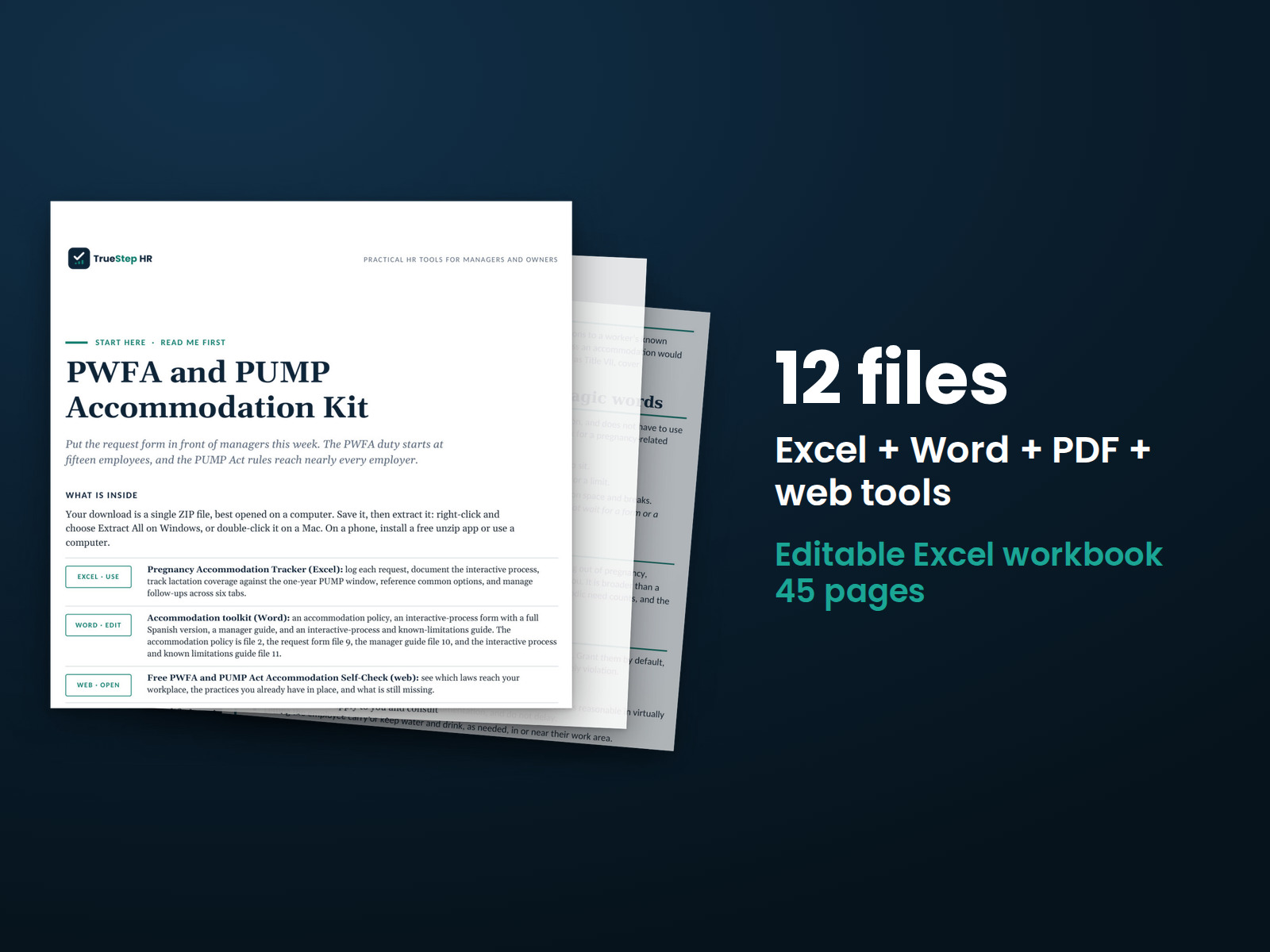
Handle a pregnancy or nursing accommodation the way the law now expects, from the first request to a documented decision you can stand behind: a policy to adopt, a bilingual form that is also the record, guides for HR and managers, and a tracker that watches the response times and the one-year lactation window.

$99USD

One-time purchase, no subscription. Instant download.

Built by expert HR practitioners and leaders

  • A policy you adopt once: fourteen sections covering both duties, the 15-employee PWFA threshold and the all-sizes PUMP rules, how an employee asks without magic words, the four accommodations granted by default, the limits on medical documentation, and the rule against forced leave
  • A bilingual request form that is also the record: the employee asks in plain words, HR documents the interactive process and the decision on the same form, and a full Spanish version follows the English one
  • Guides for HR and for managers: a 12-section interactive-process guide for whoever runs the process, and a short manager playbook with what to avoid saying and seven common questions answered
  • A six-tab tracker that watches the dates: response times, status flags, and the one-year lactation window calculate for you, with an options reference and a compliance log alongside
  • A readiness self-check: a browser tool that asks two routing questions, scores eight practices, and returns the gaps to close, running locally and uploading nothing

The kit structures the request, the process, and the record. It does not decide that a situation complies, and it routes the close calls, undue hardship and any denial among them, to qualified employment counsel.

One-time purchase Instant download Editable files 14-day guarantee

Policy and form templates, guides, a tracker, and general business information, not legal or tax advice. The PWFA and the PUMP Act are federal law, parts of the pregnancy-accommodation rule are in litigation, and many states are more protective, so confirm the current rules that apply to you and have qualified employment counsel review your policy and any close call before you rely on a determination.

Last reviewed June 2026

One-time purchaseNo subscription
Instant downloadFiles you keep
Editable filesExcel, Word, PDF
14-day guaranteeMoney back
Secure checkoutSSL encrypted
What you get

Seven pieces that carry an accommodation from the first request to a clean record

Adopt the policy, put the form in front of managers, run each request with the guides, and log it as you go. The self-check tells you where you stand before the first request arrives. Built to be used together.

PDFStart here

Start Here

A one-page map of the kit: confirm which laws reach you, adopt the policy, route every request through the form, work the process with the guides, and track the dates, with the counsel moments named.

DOCXWord

The Accommodation Policy (14 sections)

An internal policy that sets the 15-employee PWFA threshold and the all-sizes PUMP duty, the no-magic-words request, the interactive process, the four default accommodations, documentation limits, no forced leave, nursing breaks and a private non-bathroom space, confidentiality, and retaliation. Editable Word with a print-ready PDF.

DOCXWord

The Request and Interactive-Process Form (English and Spanish)

One form the employee uses to ask and HR uses to record the conversation and the decision. It captures the limitation in general terms with no diagnosis, opens with a confidentiality note, and includes a full Spanish version flagged for review by a Spanish-speaking professional. Editable Word with a print-ready PDF.

DOCXWord

The HR Interactive-Process Guide (12 sections)

The working guide for whoever runs the process: recognizing a request, what a known limitation is, the assessments to grant by default, when documentation is and is not appropriate, undue hardship, what to document, and a neutral note on the litigation and on more protective state law. Editable Word with a print-ready PDF.

DOCXWord

The Manager Guide and FAQ

A short playbook for line managers: how to recognize and route a request, an avoid-these list for the first conversation, the PUMP break and space basics, confidentiality, and seven common questions answered. Editable Word with a print-ready PDF.

XLSXExcel

The Accommodation Tracker (6 tabs)

Logs each request, records the interactive process, tracks the one-year lactation window, keeps an options reference, and holds a compliance log. Response times, status flags, and the coverage window calculate, and it opens on a worked example. Works in Excel or Google Sheets.

HTMLWeb

The Readiness Self-Check

A browser tool that asks two routing questions, scores eight practices against both laws, and returns the gaps to close. It runs locally and uploads nothing.

How it works

The method in the order a request runs

Adopt the policy, then run every request the same way: recognize it, work the interactive process, grant what the law grants by default, and keep the record. The kit structures each step; you make the calls, and counsel covers the close ones.

STEP 01

Set the policy and brief managers

Adopt the policy so the rules are written down, and give managers the short guide so a request does not stall or get mishandled at the first conversation. The avoid-these list covers what not to say before HR is in the room.

STEP 02

Take the request without magic words

An employee does not need a form, a doctor's note, or any special phrase to ask. Capture the limitation in general terms and the accommodation on the form, and keep the medical detail with HR, separate from the personnel file.

STEP 03

Grant the predictable assessments now

Water near the work area, extra restroom breaks, sitting or standing as needed, and breaks to eat and drink are reasonable in virtually every case under the EEOC rule. Grant them without documentation or delay, and log them.

STEP 04

Work the interactive process for the rest

For anything beyond those four, use the HR guide and the form to document the conversation, the options considered, and the outcome, and ask for only minimal documentation when it is appropriate at all. Do not move someone to leave if a reasonable accommodation lets them keep working.

STEP 05

Track the dates and the lactation window

Put each request and each nursing employee in the tracker so response times, follow-ups, and the one-year PUMP window are watched, and the private space and break time are recorded as in place. Unnecessary delay can itself violate the rule, so the response clock matters.

The standard

Built on the current federal rules and careful where it counts

Accommodation disputes trace back to the same patterns: a request nobody recognized because it came in plain words, a manager who asked for a diagnosis, a simple stool request that sat for weeks, and an employee moved to leave when a small change would have kept them working. The fix is one consistent process with the record kept as you go, and this kit gives you all of it, with the moments to stop and get qualified help marked.

The PWFA has applied to employers with 15 or more employees since June 2023, and the EEOC rule in force since June 2024 names four accommodations, water near the work area, extra restroom breaks, sitting or standing, and breaks to eat and drink, as reasonable in virtually all cases. The PUMP Act reaches nearly every employer with no size floor, for up to one year after birth, and its delayed coverage for certain rail and motorcoach employees began December 29, 2025. The durable pattern is the one the kit builds: take the request in plain words, grant the predictable four, document the rest, and watch the clock.
No magic words, and no diagnosis. A request counts when an employee tells someone about a limitation in plain language. Asking for a diagnosis, or any documentation for the four predictable assessments or a lactation request, is itself the misstep.
Leave is the last resort, not the easy answer. The rule bars forcing leave when another reasonable accommodation lets the employee keep working. The cheaper and safer move is usually the small change: the stool, the schedule, the lifting help.
The clock is part of the duty. Unnecessary delay in responding can itself violate the PWFA, even when the accommodation is eventually granted. The tracker's business-day response time exists for exactly this reason.

The kit tells you when to call a lawyer

Most requests can be taken, granted, and logged in-house with the policy, the form, and the tracker. Some calls carry real exposure, and the kit marks them, so you get qualified input before you act rather than after.

Denying any accommodation request, or relying on undue hardship to limit one A request where the limitation, the role, or the accommodation is contested or unclear Leave as the accommodation, or an employee who cannot perform an essential function even with one Termination, discipline, or any adverse action close in time to a request A complaint of retaliation, interference, or a confidentiality breach Multi-state workforces where a state law is more protective than the federal floor

Who does what

Pregnancy and nursing accommodations split the work between you, the kit, and your counsel. Here is the split, stated plainly.

  • The kit structures the process; you run it. The policy, the form, the guides, and the tracker keep every request consistent. Taking the request, working the conversation, and keeping the log current are yours to do.
  • The tracker watches the dates; you act on them. Response times, follow-up flags, and the one-year window calculate on their own. A flag is a prompt to move, never proof the duty was met.
  • The kit flags the legal lines; counsel rules on them. A denial, an undue-hardship call, forced leave, or an adverse action near a request is a signal to get qualified input. The kit tells you when a matter needs a lawyer; counsel tells you what to do about it.
  • The kit states the federal floor; counsel confirms your states. The PWFA and PUMP duties are built in as of the June 2026 review date, and many states are more protective. Confirm the rules for every state where you operate before you rely on them.
  • The kit keeps medical detail out of the file; you keep it that way. Every form and log captures the limitation in general terms and the accommodation, never a diagnosis, stored separately from the personnel file. Managers share only the operational fact of a change.
Is this for you

Who it is built for

Who this kit fits, and where to go if that is not you.

Built for

  • An owner or HR team of one at a company that has just crossed 15 employees and now carries the PWFA duty for the first time.
  • An HR lead who wants one consistent way to handle pregnancy and nursing requests across managers, with the policy, the guides, the form, and the tracker in one place.
  • A manager or people leader who needs to know what to do, and what not to say, when an employee asks to sit more, lift less, or take time to pump.

If you’re looking for

Questions

Before you buy

What format are the files and can I edit them?
The policy, the form, and the two guides ship as editable Word files with print-ready PDFs, the tracker is an Excel workbook that also works in Google Sheets, the Start Here is a PDF, and the self-check opens in any browser. Everything is editable and yours to keep, and the self-check runs locally and uploads nothing.
Is this legal advice?
No. It is general information and a structured process for planning. Accommodation calls under the PWFA and the PUMP Act carry real legal consequences, so the kit marks where to bring in qualified employment counsel, and you should do that before you act.
Does the PWFA apply to my company?
The PWFA covers employers with 15 or more employees; the PUMP Act applies at nearly every size, with only a narrow undue-hardship exemption under 50 employees. The self-check asks your headcount first and tailors the points to it, and the policy and guides cover both duties.
Is this still valid given the court cases about the PWFA?
The core accommodation framework is in force and enforced. A federal court vacated the part of the EEOC rule that treated purely elective abortion as a covered condition, and a separate challenge to how the law was enacted is before a federal appeals court with a decision pending. The kit notes this neutrally, tells you to follow what the agency currently requires, and carries a last-reviewed date.
How does it protect employee privacy?
Every form and log captures the limitation in general terms and the accommodation, never a diagnosis. The records are treated as confidential and kept separate from the personnel file, and managers are told to route any medical detail to HR.
Is the Spanish form ready to hand out?
It is a complete translation provided for convenience and flagged for review by a Spanish-speaking HR or legal professional before use. Keep it confidential and separate from the personnel file, the same as the English version.
What is the refund policy?
Digital products are covered by a 14-day money-back guarantee. See the refund policy for the full terms.
What happens after I buy?
Checkout delivers an instant download link, and a receipt with the same link arrives by email. Open the Start Here page first; it tells you the order to work in. If a file gives you trouble, email support@truestephr.com.
Can I expense this purchase to my business?

Most customers buy TrueStep HR tools for business use, and a tool you use for work often qualifies as a deductible business expense. Whether it does for you depends on your situation, so confirm with your accountant or tax professional. Your receipt arrives by email at checkout and works as documentation.

Free guide

The 6 red flags to check before you discipline or fire someone

A five-minute screen that catches the most common and most expensive people-decision mistakes before they happen. Free PDF, sent to your inbox. Unsubscribe anytime.

Get the kit

Take the next request the way the law expects

Adopt the policy, hand managers the guide, take the request in plain words, grant the predictable four without delay, and keep the record and the dates in one tracker, in files you keep, with the counsel moments marked.

$99
One-time purchase, no subscription

Policy templates, guides, and a tracker, not legal or tax advice. Last reviewed June 2026.