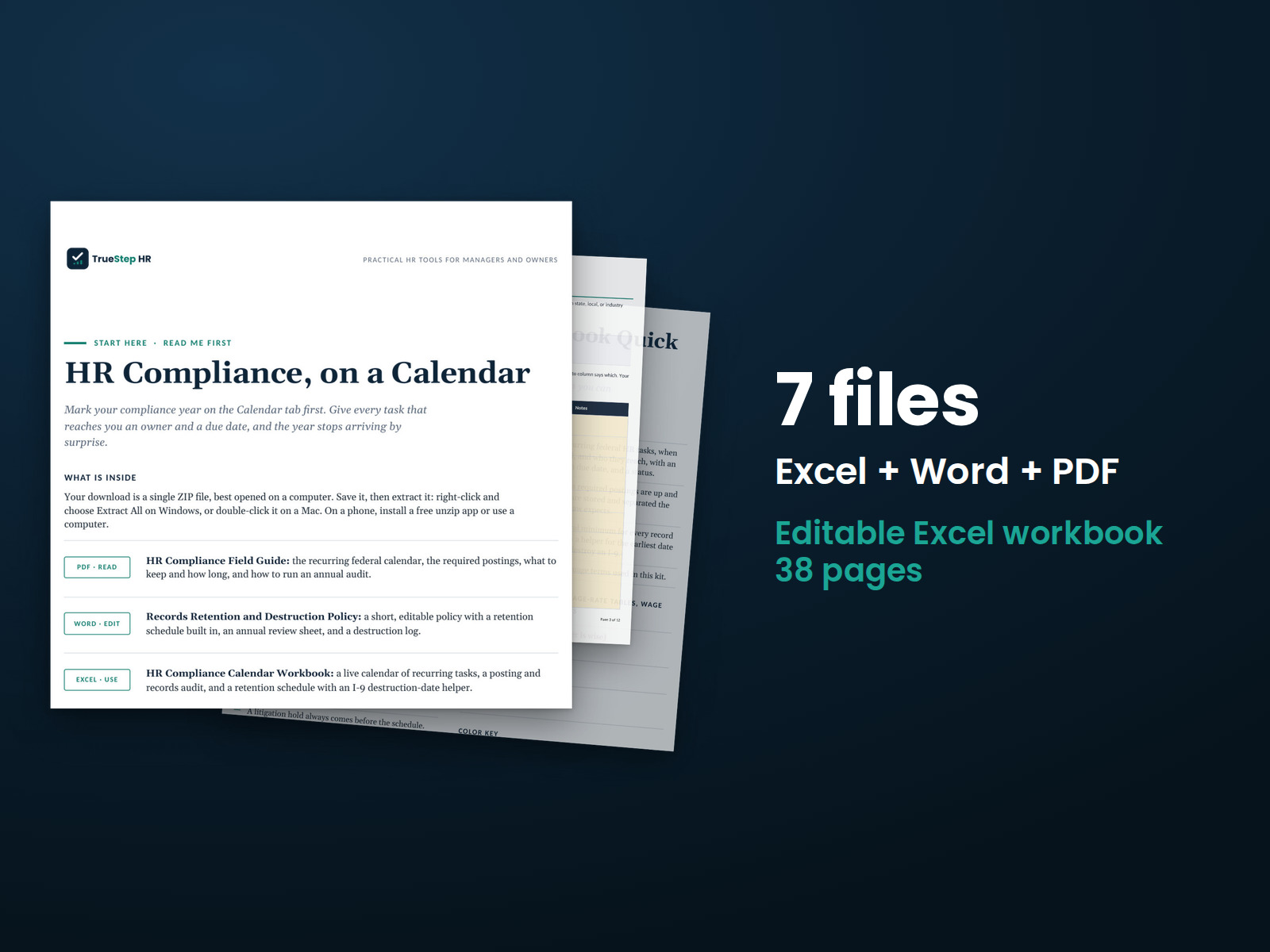
Real pages from the kit files. The helper dates are a worked example.
HR Compliance Calendar and Document Audit Kit
Put every recurring HR deadline, posting, and record on one calendar with an owner and a date beside it. Run the audit once a year, keep each record exactly as long as the rules require, destroy what is past its period and log it, and let the kit mark the moments to bring in counsel.
One-time purchase, no subscription. Instant download.
Built by expert HR practitioners and leaders
- A Field Guide to the compliance year: 13 pages on the recurring federal calendar month by month, the postings on your wall, what to keep and how long, destruction and legal holds, the annual audit, and the duties that arrive as you grow
- A live compliance calendar: 21 recurring federal tasks with cadence, typical timing, and who each one reaches, plus owner, due date, and status columns and room for your own state, local, and industry items
- A document and posting audit: the six federal postings with who must display each, and twelve records checks confirming every file is stored and separated the way the rules expect, with a last-checked date on each line
- A retention schedule with an I-9 helper: the federal minimum for thirteen record types with the authority behind each, and a helper that returns the earliest date you may destroy an I-9 from the hire and end dates
- An adoptable retention and destruction policy: a short Word policy with fill-in fields and a built-in schedule, plus an annual compliance review sheet and a destruction log that proves you followed your own rules
The kit structures the calendar, the audit, and the record. It does not file anything for you, and it routes the legal calls to qualified counsel.
Want it set up with you? Add a 60 minute implementation session, $149 →
A compliance calendar, an audit, and a retention system, and general business information, not legal or tax advice. Deadlines, thresholds, and retention periods change and vary by state and locality, so confirm the current requirements everywhere you operate, and get qualified help before you purge any record tied to an open claim, charge, or audit.
Last reviewed June 2026
Four files that turn scattered compliance duties into one system
Read the Field Guide first for the lay of the land. Map your year on the calendar, run the posting and records audit, adopt the retention policy so your rules are written down, and log every purge. Built to be used together.
Start Here
A one-page map that sets the order: read the Field Guide, map your year on the calendar, adopt the policy, run the audit, and keep it current as laws and your headcount change. It also carries the kit's standing rule, confirm your state and your size, because the federal dates are floors and many duties start at a headcount.
The Field Guide (13 pages)
The plain-language walk through the compliance year in twelve sections: why a calendar beats a good memory, the recurring federal tasks month by month and who each reaches, the required postings and how posting works for remote staff, which files stay separate, how long to keep each record, destruction and the litigation hold that stops it, the annual audit, the duties that arrive as you grow, and the moments worth a phone call.
The Retention and Destruction Policy
A short policy written to be adopted, with shaded fill-in fields for the business name, the records officer, the effective date, and the version, a built-in retention schedule, rules for the confidential files and legal holds, and how records are destroyed. Behind it sit an annual HR compliance review sheet covering ten areas and a records destruction log that proves every purge followed the policy.
The Compliance Calendar Workbook
The running system: the calendar of 21 recurring federal tasks with an owner, a due date, and a status on each, the document and posting audit, the retention schedule with the I-9 destruction date helper, and a plain-language definitions tab. It works in Excel or Google Sheets, with an at-a-glance band that counts what is open and past due.
The method in the order the year runs
Map the year, audit what you have, set the retention rules, purge on schedule, and repeat on a cadence. The kit structures each step; you make the calls, and counsel covers the close ones.
Read the landscape, then map your year
Read the Field Guide once for the lay of the land: the compliance year, the postings, the records, and the moments worth a phone call. Then open the calendar, mark which of the 21 tasks reach you using the Applies to column, set an owner and a first due date for each, and add rows for your own state, local, and industry obligations so the whole year lives in one place.
Audit the postings and the files
Stand where your employees stand and confirm each required notice is up, current, and readable, with remote staff able to reach the electronic versions. Then walk the records check line by line: one personnel file per employee, and the medical, I-9, and background-check files stored separately with limited access. Note the date you checked, and give every fix an owner and a due date on the calendar.
Adopt the retention policy and name an owner
Open the Word file, fill in the shaded fields, confirm the retention periods against your state, and name a records officer to own retention, destruction, and legal holds. The federal periods in the schedule are floors; lengthen where state law, a contract, or an insurer requires it, never shorten below a federal minimum, and have the policy reviewed before you adopt it.
Purge on schedule and log every destruction
Once a record is past every retention period that applies and no hold is in place, destroy it securely, shred paper, wipe digital copies, and record what was destroyed, the date range, the method, and who authorized it on the destruction log. The moment you anticipate a claim, charge, audit, or investigation, stop: a litigation hold beats the schedule every time.
Run the annual review and revisit at every change
Complete the annual compliance review sheet once a year with the workbook open, postings, I-9s, storage, the purge, classifications, the handbook, filings, benefits notices, workers' compensation, and the state and local layer, and sign it. Revisit the calendar whenever a law changes or your headcount crosses 15, 20, 50, or 100, because new duties switch on at each count.
Every deadline owned, every record accounted for
Small-business compliance fails in patterns: a January filing nobody owned, a poster two versions old, a medical note in the general personnel file, a record purged during a dispute. The fix is a small system, a calendar with owners, an audit you repeat, retention rules in writing, and a log of every purge, and this kit gives you all of it, with the moments to stop and get qualified help marked.
The kit tells you when to call a lawyer
Most of the compliance year can be run in-house with the calendar, the audit, and the policy. Some moments carry enough legal weight that a quick call to an employment attorney or a benefits advisor is the cheap option, and the kit marks them. Advice before you act is far cheaper than defending an outcome after.
Who does what
Running the compliance year splits the work between you, the kit, and your counsel. Here is the split, stated plainly.
- The kit structures the system; you run it. The calendar, the audit, the schedule, and the policy organize the work and keep it consistent. Setting the owners and dates, walking the audit, and holding the cadence are yours to do.
- The calendar lists the federal core; you add your layer. The 21 tasks cover the recurring federal obligations most small employers meet. State, local, and industry deadlines, paid sick leave, state filings, pay data reports, go on the same calendar in the rows left for them, so nothing lives in two places.
- The kit flags the legal moments; counsel rules on them. A charge, a hold question, a multi-state move, or a benefit-plan filing is a signal to get qualified input. The kit tells you when a matter needs a lawyer; counsel tells you what to do about it.
- The schedule states the federal floors; counsel confirms your states. Retention periods, thresholds, and posting duties vary by state and locality and change over time, and the kit treats every period as a minimum. Current requirements for every place you operate are confirmed with qualified help before you rely on them.
- The kit keeps the record, and the record is the point. A calendar with owners, a dated audit, a signed annual review, and a destruction log with every purge on it are what defensible recordkeeping looks like on paper.
Who it is built for
Who this kit fits, and where to go if that is not you.
Built for
- An owner or office manager running compliance without an HR team, who needs the deadlines, the postings, and the records in one place with a name and a date beside each, instead of a memory and a drawer.
- An HR team of one inheriting scattered files and unwritten habits, who wants a defensible system on day one: a calendar with owners, an audit to repeat, and retention rules in writing with a log behind them.
- An operations or finance leader at a growing company, who has to know which duties switch on at 15, 20, 50, and 100 employees and prove the records were kept, separated, and purged correctly.
If you are looking for
- Governing the AI tools inside hiring and HR, with a written policy and a scored risk check on every tool. The AI in HR Policy and Risk Checklist is built for that; this kit keeps the broader compliance year.
- A complaint or charge has landed and you need to run a fair workplace investigation. This kit puts the hold up and preserves the records; the Employee Relations and Workplace Investigations Kit runs the process.
- Deciding and documenting a specific discipline or termination. The retention schedule keeps those records; the Discipline and Termination Decision Kit structures the decision itself.
Before you buy
What format are the files and can I edit them?
Is this legal advice?
We are under 15 people. Does most of this even apply to us?
How is this different from a free compliance checklist?
Does it cover the laws in my state?
What is the refund policy?
What happens after I buy?
Can I expense this purchase to my business?
Most customers buy TrueStep HR tools for business use, and a tool you use for work often qualifies as a deductible business expense. Whether it does for you depends on your situation, so confirm with your accountant or tax professional. Your receipt arrives by email at checkout and works as documentation.
The 6 red flags to check before you discipline or fire someone
A five-minute screen that catches the most common and most expensive people-decision mistakes before they happen. Free PDF, sent to your inbox. Unsubscribe anytime.
Put your compliance year on one calendar
Map the deadlines, audit the postings and the files, set the retention rules in writing, and log every purge, in files you keep, with the kit telling you when to bring in counsel.
A compliance calendar, audit, and retention system, not legal or tax advice. Last reviewed June 2026.