HR calculator

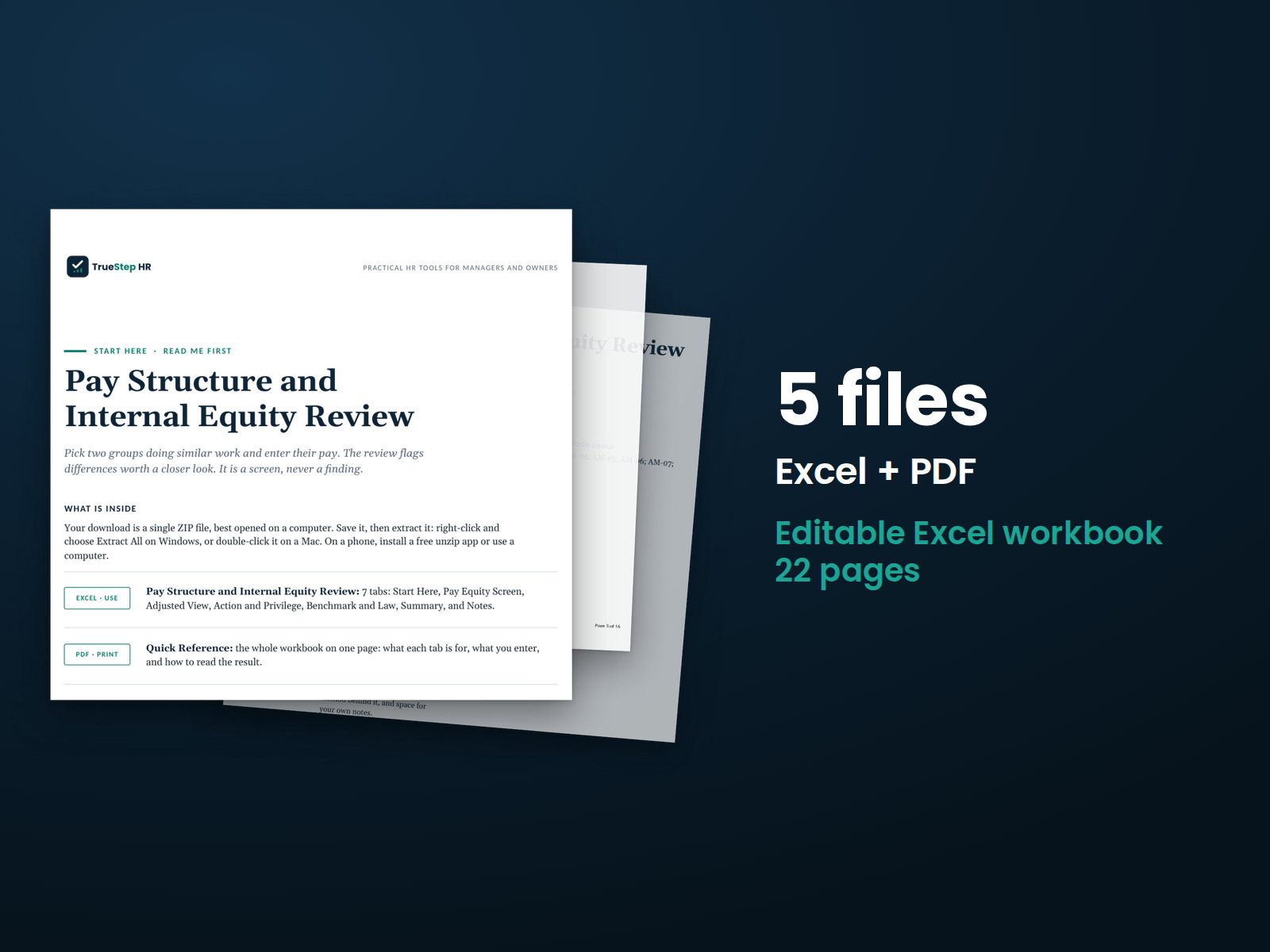
Pay Structure and Internal Equity Review

A structured self-assessment

Run a directional pay-equity self-assessment on two groups in your workforce. Assign each person to a group, enter pay, time in role, and performance, and the workbook shows the raw pay gap, then the gap that remains after accounting for time in role, so you know whether a deeper review under counsel is warranted.

$39USD

One-time purchase, no subscription. Instant download.

Built by expert HR practitioners and leaders

  • A two-group comparison built for you: assign each person to Group 1 or Group 2, enter pay, years in role, and performance, and the workbook lines the groups up for review
  • The raw pay gap, average and median: the headline difference between the groups in dollars and percent, the number a question usually starts from
  • An adjusted view that accounts for time in role: a single-factor regression removes the part of the gap explained by tenure, leaving the unexplained gap stated plainly
  • Honest small-sample guidance: the workbook flags when the group is too small to read statistically and says what a defensible review needs, so a directional result is not overread
  • Open, editable formulas in Excel or Google Sheets, with a worked example pre-filled, plus a tab that lays out how to escalate a serious gap under attorney privilege

The workbook flags where pay looks uneven and what time in role explains. Whether a gap is a problem, and what to do about it, is a judgment for you and, where it is serious, for counsel.

Want it set up with you? Add a 60 minute implementation session, $149 →

One-time purchase Instant download Editable files 14-day guarantee

Planning estimates and general business information, not legal or tax advice. This is a directional self-assessment, not a statistical pay-equity audit, and it does not create any privilege. Review anything it surfaces with a qualified employment attorney before you act.

Not the right fit? Take the 60-second match.

Last reviewed June 2026

One-time purchaseNo subscription
Instant downloadFiles you keep
Editable filesExcel, Word, PDF
14-day guaranteeMoney back
Secure checkoutSSL encrypted
What you get

One Excel workbook that screens two groups for a pay gap

A working model, not a blank grid. You sort people into two groups, the workbook measures the gap and what tenure explains, and it opens on a filled-in example so the read is clear before you load your own data.

XLSXExcel + Sheets

Pay Structure and Internal Equity Review

Assign each person to one of two groups and enter pay, time in role, and performance. The workbook returns the raw gap in pay between the groups, then an adjusted gap that accounts for time in role, and opens on a filled-in example so the read is clear before you load your own data.

XLSXBuilt in

The adjusted view, the summary, and what to do next

An Adjusted View tab isolates how much of the gap time in role explains and what is left over. A summary rolls it onto one page. An Action and Privilege tab and a Benchmark and Law tab document the limits of a self-assessment and how to run a real analysis under counsel, so the result is used the way it is meant to be.

How it works

Three steps from your pay data to a clear read

You sort people into two groups, the workbook measures the gap, and an adjusted view tells you how much of it tenure explains.

STEP 01

Build the two groups

Assign each person to Group 1 or Group 2 and enter pay, years in role, and performance.

STEP 02

Read the raw gap

The workbook shows the average and median pay gap between the groups in dollars and percent.

STEP 03

Account for tenure, then decide

The adjusted view removes the part of the gap time in role explains and states what is left, so you know whether to escalate it under counsel.

The standard

A screen that knows what it is and what it is not

A directional self-assessment points you to where pay looks uneven; it does not deliver a finding, because a defensible finding needs a controlled analysis run under privilege.

Across the labor market a raw pay gap often runs near twenty cents on the dollar, and most of it closes once role, level, and tenure are accounted for. A gap that survives those controls is the one worth investigating, and that is an analysis for counsel, not a workbook.
A screen, not a verdict. The workbook reports the gap in plain dollar and percent terms and stops short of claiming a finding, because a pay-equity finding needs a controlled statistical analysis run under privilege.
The adjustment that matters. Removing time in role shows how much of a gap is explained by tenure rather than by group, which is the first question any real review asks.
Honest about sample size. The workbook says when a group is too small to read statistically and what a defensible review needs, so a directional result is not mistaken for proof.
Is this for you

Who this review fits and where to go if that is not you

It is built for a structured first look at internal equity. For a defensible audit or the structure itself, the right path is below.

Built for

  • An HR or comp lead who wants a structured first look at internal equity before deciding whether to commission a full audit.
  • An owner or HR team of one putting eyes on pay for the first time and needing to know where the problems are.
  • A consultant or fractional HR lead who runs a directional equity screen for clients and wants the method and its limits documented.

If you are looking for

  • A privileged statistical pay-equity audit you can stand behind in a dispute. That is an engagement with employment counsel and an analyst, and this tool routes you there on purpose.
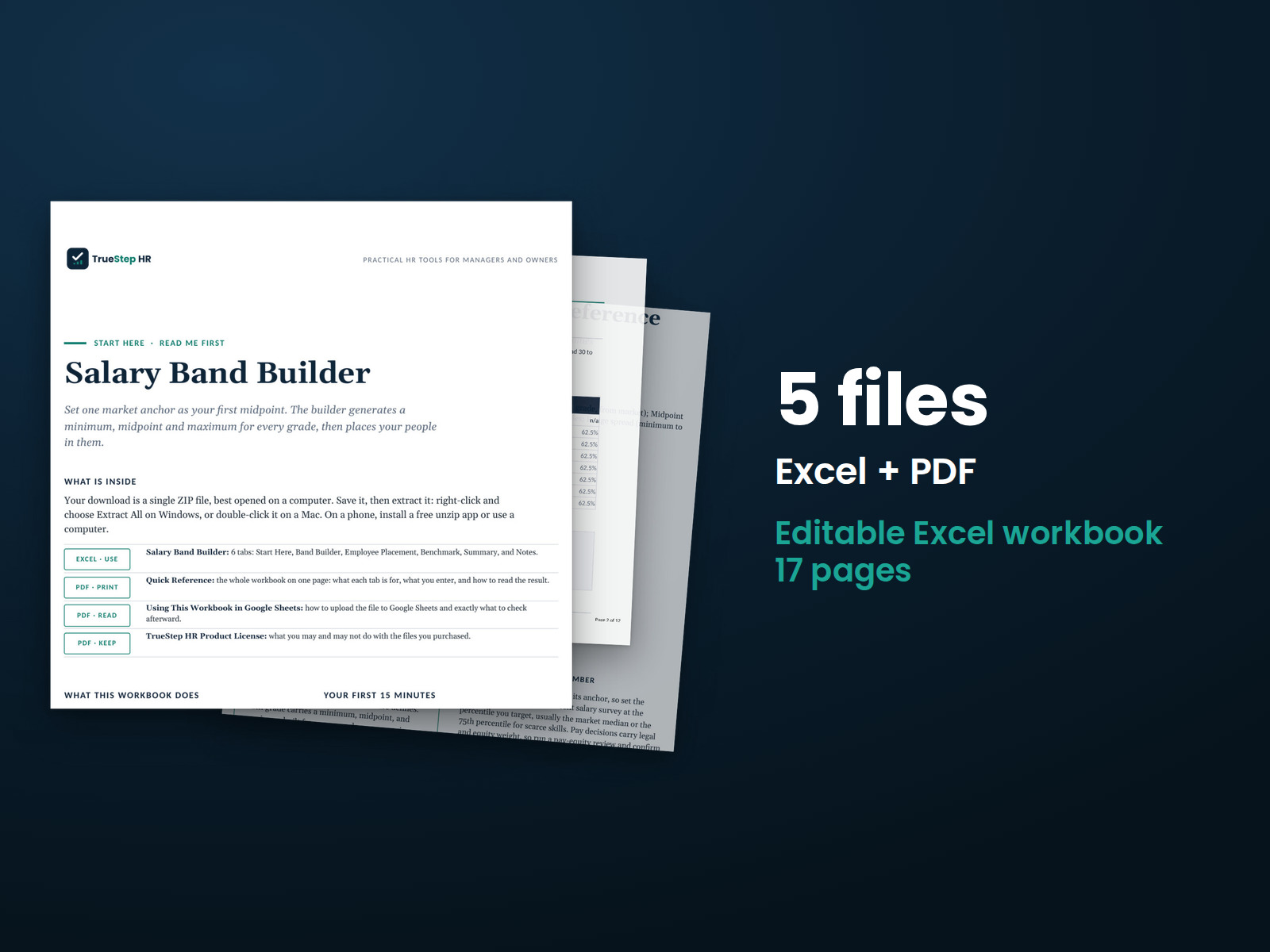
  • A whole pay structure to screen against. The Salary Band Builder builds the grades and ranges this review reads people against.
Questions

Before you buy

What format is it and can I edit it?
It is one Excel workbook that also works in Google Sheets. Every input and formula is editable, and the file is yours to keep. Duplicate it to screen another pair of groups.
Is this a pay-equity audit?
No, and it does not pretend to be. It is a directional self-assessment that flags where pay looks uneven so you know where to look. A defensible pay-equity audit is a controlled statistical analysis run under attorney privilege. If this screen raises something serious, take it to counsel.
How accurate is the result?
The gap math is exact for the data you enter, and the adjusted view correctly removes the part of the gap that time in role explains. What it cannot do is control for every legitimate factor behind a pay difference, which is the work an audit does, so read each result as a question to investigate, not an answer. On a small group, treat it as directional only.
Does it include market or survey data?
No. It reads the pay, tenure, and performance you enter for your own people. Pull current market data separately if you need it.
What is the refund policy?
Digital products are covered by a 14-day money-back guarantee. See the refund policy for the full terms.
What happens after I buy?
Checkout delivers an instant download link, and a receipt with the same link arrives by email. Open the workbook in Excel or Google Sheets and start with the example before you load your own data. If a file gives you trouble, email support@truestephr.com.
Can I expense this purchase to my business?

Most customers buy TrueStep HR tools for business use, and a tool you use for work often qualifies as a deductible business expense. Whether it does for you depends on your situation, so confirm with your accountant or tax professional. Your receipt arrives by email at checkout and works as documentation.

Free guide

The 6 red flags to check before you discipline or fire someone

A five-minute screen that catches the most common and most expensive people-decision mistakes before they happen. Free PDF, sent to your inbox. Unsubscribe anytime.

Get the calculator

See whether your pay gap survives the obvious explanations

The raw gap, the gap after time in role, and an honest read on sample size, in a file you keep.

$39
One-time purchase, no subscription

Planning estimates and general business information, not legal or tax advice. Last reviewed June 2026.